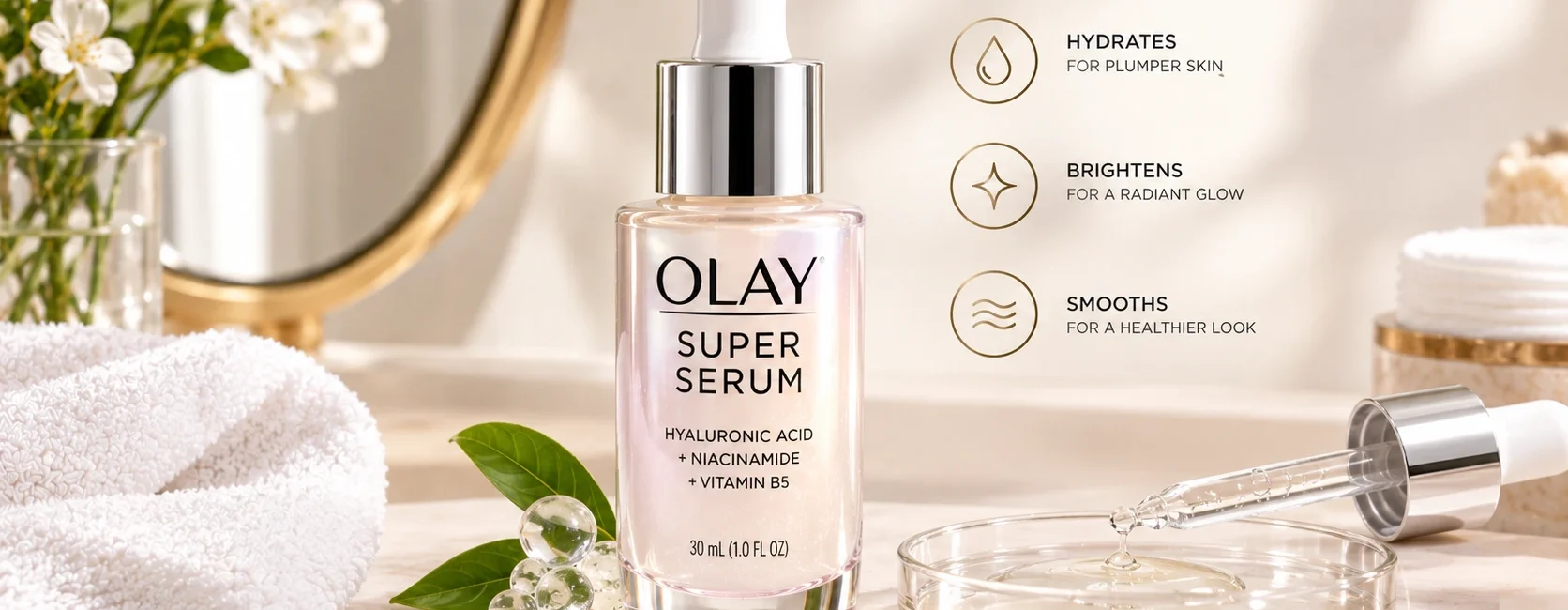
Olay Super Serum is marketed with a bold claim: five separate skincare benefits from one product. That kind of “does everything” positioning usually deserves skepticism; most multi-benefit serums are a marketing bundle of diluted actives. Olay Super Serum is a more interesting case than most, because there’s a real formulation reason it can combine ingredients that don’t normally play well together in the same bottle. Here’s what’s actually in it, why the pH matters more than most reviews mention, and whether it’s worth adding to your routine.
What Is Olay Super Serum?
Olay Super Serum is a lightweight, fast-absorbing face serum built around five active ingredient categories: niacinamide, vitamin C, a collagen-supporting peptide, vitamin E, and an alpha hydroxy acid (AHA). It’s sold in 1 fl oz (30ml) and smaller travel-size bottles, positioned within Olay’s broader Regenerist and Vitamin C skincare range, and marketed for improved texture, more even tone, firmer-feeling skin, smoother fine lines, and hydration the “5 benefits in 1” the packaging leads with.
The Ingredient List, in Plain English
The full ingredient list (per current retailer-published data) includes: water, glycerin, dimethicone, niacinamide, lactic acid, polyacrylate crosspolymer-6, palmitoyl pentapeptide-4, 3-O-ethyl ascorbic acid, sodium hyaluronate, tocopheryl acetate, panthenol, trehalose, PEG-11 methyl ether dimethicone, sodium lactate, mica, titanium dioxide, sodium benzoate, and fragrance.
Translated:
- Niacinamide — vitamin B3, supporting barrier function, tone, and texture.
- Lactic acid — the AHA in the formula, a gentler exfoliating acid than glycolic acid, supporting texture and mild resurfacing.
- Palmitoyl pentapeptide-4 — a peptide associated with supporting the skin’s collagen-related processes, the ingredient behind the “firmer feeling skin” claim.
- 3-O-ethyl ascorbic acid — this is the vitamin C form, and it’s a meaningful detail most reviews skip. Unlike pure L-ascorbic acid, which oxidizes and degrades quickly once exposed to air and light, this is a more stable vitamin C derivative, which matters practically because it means the vitamin C in your bottle is more likely to still be active by the time you’re halfway through using it.
- Sodium hyaluronate — a form of hyaluronic acid, supporting hydration.
- Tocopheryl acetate — vitamin E, an antioxidant.
- Panthenol and trehalose — supporting ingredients for hydration and barrier comfort.
- Mica and titanium dioxide — these are cosmetic colorants responsible for the serum’s shimmery, iridescent appearance in the bottle. Worth being clear about this one: the shimmer is a sensory/visual cue, not an active skincare ingredient, and it’s not doing anything for your skin beyond looking distinctive in the bottle and briefly on application.
- Fragrance — present in the standard formula, which matters if you’re fragrance-sensitive.
Why the Formulation Science Actually Matters Here
Most multi-benefit serums run into a real chemistry problem: niacinamide and AHAs (like lactic acid) don’t traditionally combine well at a single stable pH. Niacinamide tends to perform best in a more neutral-to-mildly-acidic range, while effective AHA exfoliation typically wants a lower, more acidic pH, and vitamin C in its unstable pure form (L-ascorbic acid) also needs a specific low pH to stay effective. Getting niacinamide, an AHA, and vitamin C to coexist in one stable formula without one ingredient undermining another isn’t trivial.
Olay Super Serum’s formula is built around a pH close to 3.8, using the more stable 3-O-ethyl ascorbic acid vitamin C derivative specifically because it tolerates that pH range better than pure L-ascorbic acid would. This is the genuine engineering story behind the “5-in-1” marketing claim: it’s not just five ingredients dumped into a bottle; it’s a formula built around ingredient choices that can coexist at a specific pH rather than degrading each other. That’s a legitimate differentiator worth knowing, even though it’s rarely explained in typical product roundups.
The practical tradeoff: a pH around 3.8 is meaningfully acidic, which is part of why some users report tingling or mild irritation, particularly on first use or on already-compromised or very sensitive skin.
What Olay Actually Claims (and How to Read It)
Olay’s own marketing describes a timeline: improved skin texture around week 1, more even tone by week 2, and visible correction of fine lines and wrinkles by week 4, based on the brand’s own clinical testing across diverse skin tones and types. A few honest notes on reading this: “clinically tested” here refers to company-commissioned testing, not independent, peer-reviewed research; that doesn’t make the results false, but it’s brand-run data rather than third-party verification. The AHA content also comes with an explicit sunburn alert on the product itself, meaning the formula can increase sun sensitivity, which is why Olay specifically recommends pairing it with daytime SPF rather than treating it as a standalone step.
How to Use It
- Apply to a cleansed face and neck morning and/or night. Olay’s own directions suggest twice-daily use for best results, though starting once daily and building up is reasonable if you’re new to AHA-containing products.
- Follow with a moisturizer to lock in hydration and buffer the acid’s intensity slightly.
- Always use SPF during the day when using this or any AHA-containing product; this isn’t optional, given the increased sun sensitivity AHAs cause.
- If you’re layering with a retinol product, use them at different times (one AM, one PM) rather than stacking two potentially irritating actives in the same application.
Who Should Use Olay Super Serum
Good fit if:
- You want visible texture and tone improvement without managing five separate single-ingredient products
- You have normal, oily, or combination skin that tolerates mild acid exfoliation reasonably well
- You’re looking for a stable, shelf-life-friendly vitamin C option rather than pure L-ascorbic acid, which degrades faster
- Budget matters: at roughly $33–$38 for a 1 oz bottle in the U.S., it’s priced well below most prestige multi-active serums with a comparable ingredient list
Probably not the right fit if:
- You have very sensitive, reactive, or compromised skin; the acidic pH and AHA content are more likely to irritate a simpler, single-active hydrating serum
- You’re fragrance-sensitive and haven’t checked whether a fragrance-free version is available in your market
- You’re already using a separate retinol, AHA, or vitamin C product and don’t want ingredient overlap that increases irritation risk
Olay Super Serum vs. Other Popular Serums
| Serum | Core Actives | Best For | Texture/Feel | Approx. U.S. Price |
|---|---|---|---|---|
| Olay Super Serum | Niacinamide, vitamin C (stable derivative), peptide, vitamin E, AHA | Multiple concerns in one step, budget-conscious multi-active users | Lightweight, shimmer finish, mildly acidic | $33–$38 (1 oz) |
| Simple hyaluronic acid-only serums | Hyaluronic acid, glycerin | Pure hydration, sensitive skin, no exfoliation needed | Very lightweight, no active exfoliation | Varies, often $15–$25 |
| Korean-style glow/vitamin C serums | Often niacinamide or vitamin C-forward, gentler pH | Brightening with a lower irritation profile | Lightweight, generally lower acidity | Varies by brand |
| Prestige multi-active serums | Similar active categories at higher concentrations | Users wanting maximum potency and willing to pay more | Varies | $60–$150+ |
If gentler brightening without the AHA exfoliation is more your priority, our review of the Beauty of Joseon Glow Serum covers a lower-irritation alternative built around a different formulation philosophy. And if you want pure hydration to pair underneath an active serum like this one, our look at Neutrogena’s Hydro Boost Gel Cream covers a strong moisturizing option to layer on top.
How Olay’s Formulation Philosophy Compares to Other Drugstore Brands
Olay’s approach here, combining multiple actives into one stabilized formula rather than requiring separate single-ingredient products, is a genuinely different philosophy than brands that build routines around individual, simpler steps. If you’re weighing that broader philosophy question across brands, our comparisons of how CeraVe stacks up against The Ordinary’s single-ingredient approach and how gentle Nivea is compared to Aveeno cover how other drugstore brands approach the same multi-concern skin goals differently.
A Note on Sensitive Skin and New Users
If you’ve never used an AHA-containing product before, patch test on a small area first and introduce it gradually (every other day for the first one to two weeks) rather than jumping straight to twice-daily use. Discontinue if you experience persistent stinging, redness, or irritation beyond mild initial tingling, and consult a dermatologist if irritation doesn’t resolve after stopping use.
Frequently Asked Questions
What does Olay Super Serum actually do?
It combines niacinamide, a stable vitamin C derivative, a collagen-supporting peptide, vitamin E, and an AHA (lactic acid) in one formula, targeting texture, tone, firmness, fine lines, and hydration in a single product.
Is Olay Super Serum the same as a vitamin C serum?
Not exactly; it contains vitamin C as one of five active ingredients rather than being a pure, single-ingredient vitamin C serum. The vitamin C form used (3-O-ethyl ascorbic acid) is more stable than pure L-ascorbic acid but is present alongside four other actives rather than at maximum standalone concentration.
Why does Olay Super Serum have a shimmer in the bottle?
The shimmer comes from mica and titanium dioxide, cosmetic colorants included for visual and sensory appeal. They aren’t active skincare ingredients and don’t affect the serum’s actual performance.
Do I need to use SPF with Olay Super Serum?
Yes. The AHA (lactic acid) content increases sun sensitivity, and the product includes an explicit sunburn alert; daytime SPF use isn’t optional if you’re using this serum.
Is Olay Super Serum good for sensitive skin?
Not necessarily the best starting point. Its pH (around 3.8) and AHA content make it more likely to irritate than a simpler, non-exfoliating hydrating serum, so sensitive-skin users should patch test first or consider a gentler alternative.
How much does Olay Super Serum cost in the U.S.?
Current U.S. pricing typically runs $33–$38 for a 1 fl oz bottle, with smaller travel sizes available at a lower price point.
Can I use Olay Super Serum with retinol?
Yes, but not layered in the same application. Use one in the morning and the other at night to avoid combining two potentially irritating actives at once, especially when you’re first introducing either product.