Brenda Fricker, the Academy Award-winning Irish actress who made history as the first Irish woman to win an acting Oscar, died on Thursday, July 17, 2026, in Dublin. She was 81. Her agent Phil Belfield confirmed the news to the BBC with a tribute that captured what those who knew her most felt: “We will never see her like again, and the world is lesser for the lack of her.”
By RK Fashion Zone Editorial Team | A dedicated team researching and writing about modern fashion, beauty products, and practical outfit guides.
She had spoken openly about her health in recent years. As recently as 2025, she told The Irish Times: “As an actor you’re not an artist, but you’re surrounded by arty people. That makes it a good place to be. I still just think of it as playing games.” It was a characteristically deflecting, warm, and honest remark from an actress who spent six decades making the most demanding emotional work appear entirely effortless.
Brenda Fricker: Key Facts
| Detail | Information |
|---|---|
| Full Name | Brenda Fricker |
| Born | February 17, 1945, Dublin, Ireland |
| Died | July 17, 2026, Dublin, Ireland |
| Age at death | 81 |
| Oscar win | Best Supporting Actress, 1990 (My Left Foot) |
| Historic significance | First Irish woman to win an acting Academy Award |
| Spouse | Barry Davies (m. 1979; div. 1988) |
| Notable roles | Megan Roach (Casualty), Bridget Brown (My Left Foot), Pigeon Lady (Home Alone 2) |
| Irish Times ranking | 26th greatest Irish film actor of all time (2020) |
| Memoir | She Died Young |
| Last screen credit | The Swallow (2025), Crossmaglen |
Early Life: Dublin, Journalism, and Becoming an Actress by Chance
Brenda Fricker was born on February 17, 1945, in Dublin, Ireland. Her mother, known as Bina, was a Kerry-born teacher of languages at Stratford College in Rathgar. Her father, Desmond Fricker, worked in the Department of Agriculture and as a journalist for The Irish Times under the name “Fred Desmond,” also broadcasting with RTÉ. Journalism ran in the family.
Before she was an actress, Fricker worked as an assistant to the art editor of The Irish Times, hoping to become a reporter herself. She was nineteen years old when she became an actress, and she became one, as she always insisted, by chance rather than ambition.
Her feature film debut was a small, uncredited part in the 1964 film Of Human Bondage, based on W. Somerset Maugham’s novel. From there she built her craft through the theatre: the Abbey Theatre in Dublin, the Gate Theatre, the Royal National Theatre in London, and the Royal Shakespeare Company. She trained seriously, performed widely, and developed the formidable emotional range that would define her best screen work.
Casualty: The Role That Made Her a Household Name
Before My Left Foot, before the Oscar, Brenda Fricker was already a familiar and beloved figure to British and Irish television audiences through her role as Megan Roach in the BBC One medical drama Casualty. She joined the series at its launch in 1986 and played the warm, pragmatic staff nurse through the show’s early years, becoming one of its most recognizable faces.
Casualty gave her the sustained visibility and audience connection that set the stage for everything that followed. When My Left Foot arrived, audiences already felt they knew Brenda Fricker and that familiarity deepened rather than diminished their response to her extraordinary performance.
My Left Foot (1989): The Performance That Changed Everything
In 1989, director Jim Sheridan cast Fricker as Bridget Brown, the mother of Christy Brown, the Irish artist and writer born with cerebral palsy who could control only his left foot in the biographical film My Left Foot. Daniel Day-Lewis played Christy Brown in what became one of the most celebrated performances in cinema history. Fricker played opposite him as his fiercely loving, exhausted, endlessly resilient mother.
Her performance is a masterclass in what screen acting can do when it refuses to announce itself. She plays a woman of enormous emotional complexity: love, weariness, fierce protective pride, quiet sorrow, without a single moment of visible effort or theatrical display. Critics and audiences recognized something rare and true in what she was doing.
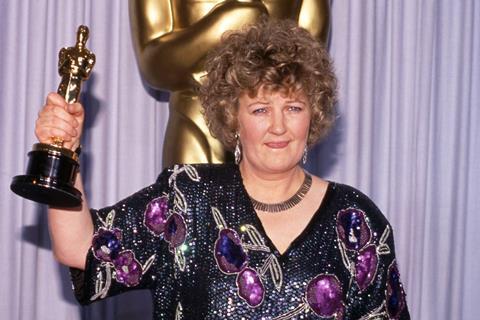
At the 62nd Academy Awards ceremony in 1990, Fricker won the Oscar for Best Supporting Actress, becoming the first Irish woman in history to win an acting Academy Award. Her acceptance speech was brief, heartfelt, and entirely characteristic; she thanked Christy Brown simply for “being alive.” The directness, the humanity, the refusal of sentimentality: it was pure Brenda Fricker.
The Oscar, which famously spent many years sitting on top of her refrigerator before being moved to “a respectable little shelf” in her Dublin sitting room, became part of Irish cultural lore in the years that followed.
After the Oscar: A Career of Sustained Quality
What followed the Oscar was a career that consistently prioritized interesting work over commercial calculation not always an easy choice, but one that produced a remarkable body of screen and stage performances across more than three more decades.
The Field (1990) — Fricker appeared alongside Richard Harris in Jim Sheridan’s next film, the powerful Irish drama about land and identity. The film earned Harris an Oscar nomination and remains one of the defining Irish films of its era.
Home Alone 2: Lost in New York (1992) — Her role as the Pigeon Lady opposite Macaulay Culkin in John Hughes’s sequel brought her to a global family audience that remains one of the most affectionate constituencies of her fanbase. The character, a lonely, gentle woman who befriends Kevin McCallister in Central Park, was played with a warmth and dignity that made her genuinely moving in the midst of a slapstick comedy franchise.
A Man of No Importance (1994) — Fricker starred alongside Albert Finney in this quiet, beautiful Irish film about an amateur theatre director in 1960s Dublin, one of her most understated and most admired performances.
Omagh (2004) — Fricker appeared in this RTE/Channel 4 television film about the 1998 Omagh bombing, one of the most important Irish films made about the Troubles.
Veronica Guerin (2003) — A supporting role in Joel Schumacher’s biographical thriller about the Irish investigative journalist.
Holding (2022) — Based on Graham Norton’s debut novel, this ITV series brought Fricker back to prominent television work and was warmly received.
The Miracle Club (2023) — Fricker provided the voice of a deceased character in this Irish-American film, one of her final significant credits.
The Swallow (2025) — Tadhg O’Sullivan’s experimental film, for which she received praise for her performance in what proved to be among her last screen appearances.
Crossmaglen — Listed among her most recent film credits.
Personal Life and Characteristic Honesty
Brenda Fricker was married to director Barry Davies from 1979 until their divorce in 1988. She lived alone in Dublin’s Liberties neighborhood in her later years, with her dog as her primary companion, a living situation she spoke about with characteristic honesty, refusing to romanticize it but equally refusing to dramatize it.
She was open about the loneliness that can accompany a life in which professional success and personal happiness don’t always coincide. “Success does not buy you happiness,” she said in multiple interviews over the years, a line she returned to because she meant it, not because it was quotable.
She was also forthright about her health in later years, stating in a well-circulated interview that she was “having a dreadful death,” a dark, gallows-humor remark that was somehow entirely consistent with the woman who thanked Christy Brown for “being alive” at the Oscars, and who said of acting, at 80 years old: “I still just think of it as playing games.” She wrote a memoir titled She Died Young, a title that is now, tragically, painfully and perfectly characteristic of her wit.
Legacy: What Brenda Fricker Gave to Irish Cinema
Brenda Fricker was ranked 26th on The Irish Times’ list of the greatest Irish film actors of all time in 2020, a list that includes luminaries spanning a century of Irish performance. The Tánaiste Simon Harris, paying tribute after her death, described her as “one of Ireland’s most celebrated and cherished actors.”
But numbers and tributes only approximate what she actually gave. She gave audiences six decades of screen and stage performances in which she made the invisible visible: the emotional interior of women who are usually kept in the background, the ordinary human dignity of mothers, caretakers, and survivors that cinema frequently uses as furniture rather than subjects.
She made Bridget Brown into a person, not a prop. She made the Pigeon Lady into someone you remembered thirty years after the film ended. She made Megan Roach someone you missed when she was gone. That is the specific gift of a character actor who is also a great one: not the ability to disappear into a role, but the ability to make the role unforgettable.
Ireland’s Tánaiste said he was “deeply saddened” to learn of her passing. Her agent said the world was lesser for the lack of her. Both things are true. What is also true is what she said herself, sitting in Dublin in 2025, with the Oscar on a shelf in the sitting room and decades of extraordinary work behind her: “I still just think of it as playing games.” That, in the end, is the whole secret.