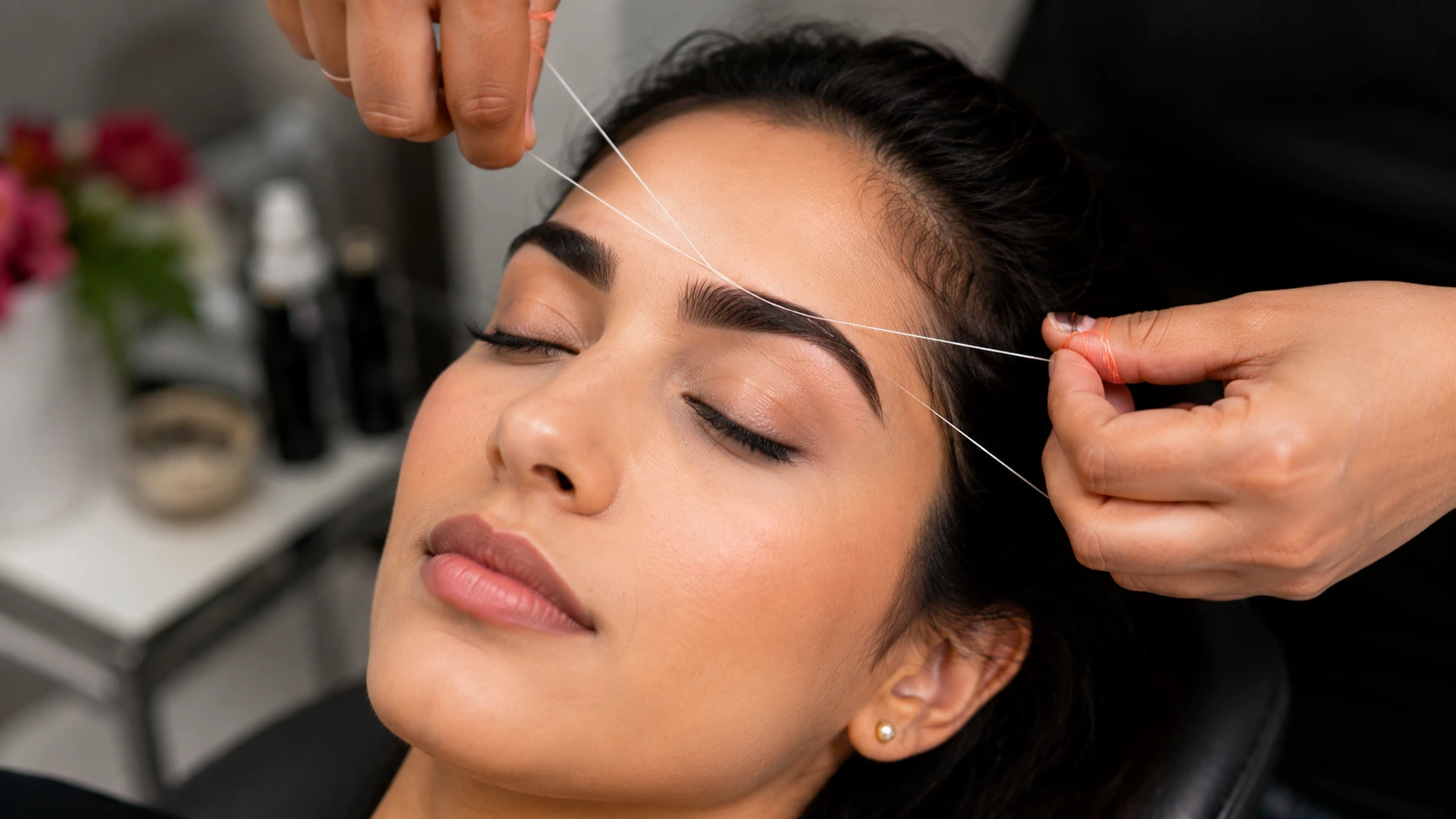
If you’ve ever left a salon with brows that look uneven, irritated, or just slightly off, you already know how much the method matters. Eyebrow threading has become the gold standard for brow shaping in the US for good reason: it’s more precise than waxing, gentler on sensitive skin, entirely chemical-free, and capable of sculpting the kind of clean, defined arch that other methods cannot replicate with the same accuracy.
By Rehan Khatri | Fashion & Beauty Writer at RK Fashion Zone.
Whether you’ve never had your brows threaded before, you’re trying to decide between threading and waxing, or you want to understand exactly what happens during a session, this is the only guide you need. We cover everything: the history, the technique, the benefits, the pain level, aftercare, cost, how often to go, and how threading compares to every alternative method available in 2025.
What Is Eyebrow Threading?
Eyebrow threading is an ancient hair removal technique that uses a thin, twisted cotton thread to pull unwanted hair directly from the follicle. The thread is looped and rolled across the skin in a precise, controlled motion, catching individual hairs or entire rows at once and lifting them cleanly from the root.
Unlike waxing, which adheres to both hair and skin, threading only contacts the hair itself. Unlike tweezing, which targets one hair at a time, a skilled threading technician can remove an entire line of hairs in a single fluid motion. The result is a sharp, symmetrical brow shape with clean edges that waxing and tweezing consistently struggle to match.
Eyebrow threading has a rich history, originating in South Asia and the Middle East, where it has been practiced for thousands of years and was often regarded as an important ritual for women in these cultures. Today it is practiced globally and has become one of the most in-demand brow services at salons and beauty bars across the United States.
How Does Eyebrow Threading Work? (Step by Step)
Understanding the process removes any anxiety about your first appointment and helps you know what to expect from start to finish.
Step 1 — Consultation and Brow Mapping: Your technician will discuss your desired brow shape and assess your natural brow growth pattern. A skilled professional will “map” the brow, identifying the ideal start point, arch, and tail based on your face shape to ensure symmetry. The goal is always twins, not just sisters.
Step 2 — Skin Preparation: The brow area is cleaned with a gentle, alcohol-free cleanser to remove any makeup, oils, or skincare products that could interfere with the thread’s grip on the hair. Clean skin is essential for the thread to work effectively.
Step 3 — Thread Preparation: The technician takes a piece of 100% cotton thread approximately 24 inches long and ties the ends together to form a loop. By holding the looped thread with both hands and twisting it several times in the middle, the technician creates a twisted center section; this is the working mechanism of the entire technique.
Step 4 — The Threading Process: You’ll be asked to hold your eyelid or the skin near your brow taut, creating a smooth surface for the thread to glide across. The technician then moves the twisted section across the skin as the twist opens and closes with the motion of both hands; it catches the hair and pulls it cleanly from the root. Rows of unwanted hair are removed in seconds.
Step 5 — Finishing and Aftercare Advice: Once the shape is complete, the technician may apply a soothing toner or aloe-based gel to calm any redness. You’ll receive aftercare guidance before leaving.
The entire appointment, including consultation and cleanup, typically takes between 5 and 15 minutes. One of the most consistent things people say after their first threading session is how fast it went.
The Key Benefits of Brow Threading
There are many reasons threading has become the preferred brow shaping method for millions of women in the US. Here are the core advantages:
1. Unmatched Precision
Threading is unparalleled in its ability to deliver precise, symmetrical eyebrows. The thin thread can target individual hairs or entire rows with pinpoint accuracy, enabling a clean shape that waxing or tweezing often cannot achieve. Technicians can get much closer to the brow line than other methods allow, giving them greater control over the final result.
2. Completely Chemical-Free
Threading uses nothing but a piece of cotton thread: no wax, no chemicals, no adhesives, no heat. For anyone who reacts to waxing products, uses retinoids or AHAs, or prefers a clean beauty approach, this is one of the biggest advantages the technique offers.
3. Ideal for Sensitive Skin
Because the thread never contacts the skin directly only the hair it doesn’t pull at the surface the way wax does. Whether oily, dry, or sensitive, eyebrow threading suits all skin types, including acne-prone and rosacea-prone skin that may experience breakouts or irritation from wax.
4. Long-Lasting Results
Because hair is removed from the root, results last significantly longer than shaving or depilatory creams. Depending on your natural hair growth cycle, threading results can last between two and six weeks before regrowth becomes noticeable.
5. Reduces Ingrown Hairs
Threading minimizes the risk of ingrown hairs because the hair is pulled out cleanly from the root, which allows for a more natural regrowth pattern. This makes it an excellent option for those prone to ingrown hairs or irritation after waxing or tweezing.
6. Slows Regrowth Over Time
Repeated threading weakens the hair follicle over time. With consistent sessions, many people find their brow hair grows back finer and sparser, meaning the gap between appointments can gradually extend.
Since beautiful brows are only one piece of a complete eye look, if you’re building out your full eye makeup routine alongside your threading appointments, our guide to the best drugstore mascaras for everyday use covers the top affordable picks that complement a sharp, freshly threaded brow perfectly.
Does Eyebrow Threading Hurt?
This is the question everyone wants answered before their first appointment. The honest answer: most people describe brow threading as a “pinching” or “tingling” sensation not comfortable, but entirely manageable.
Threading is generally considered less painful than waxing because it doesn’t pull on the skin itself, only the hair. Waxing adheres to the surface of the skin and removes a layer of dead skin cells along with the hair; threading targets only the hair shaft. For people with very sensitive skin who usually struggle with traditional methods, threading is often a significantly more comfortable experience.
Pain tolerance is individual, and the area directly under the brow tends to be more sensitive than the area above. First-time clients consistently report that the sensation is less intense than they expected, and that by the second or third session, they’ve stopped thinking about it entirely.
Tips to minimize discomfort:
- Avoid scheduling your appointment during or just before your menstrual cycle, when skin sensitivity is typically higher
- Do not apply numbing creams; they change the skin’s texture and can interfere with the thread’s grip on the hair
- Keep the skin taut as directed by your technician; this significantly reduces the pinching sensation
- Take a breath and relax; your face tensing up amplifies discomfort
Eyebrow Threading Aftercare: What to Do (and Avoid)
The area immediately after threading will likely show some redness and minor sensitivity; this is completely normal and typically fades within 30 minutes to a few hours. How you care for your skin in the hours following your appointment makes a real difference.
Do:
- Apply a gentle, fragrance-free soothing gel; aloe vera works excellently to calm any redness immediately after
- Keep the area clean for at least 12–24 hours
- Use a light, non-comedogenic moisturizer if the skin feels dry or tight
Avoid for 24 hours after threading:
- Touching or rubbing the brow area; the follicles are temporarily open, and touching them introduces bacteria
- Applying makeup directly over the freshly threaded skin
- Hot showers, steam rooms, saunas, or hot baths: heat opens pores and can increase irritation
- Direct sun exposure: freshly threaded skin is more sensitive to UV damage
- Retinoids, AHAs, or exfoliating products on or near the brow area
- Heavy exercise that causes significant sweating
Most people can resume their normal skincare routine and makeup application within 24 hours.
Eyebrow Threading vs. Waxing vs. Tweezing: Which Is Best?
| Method | Precision | Sensitive Skin | Chemicals | Lasts | Cost (USA) |
|---|---|---|---|---|---|
| Threading | Excellent | ✅ Ideal | None | 2–6 weeks | $10–$25 |
| Waxing | Good | ⚠️ Caution needed | Wax/Resins | 3–6 weeks | $15–$35 |
| Tweezing | Good | ✅ Gentle | None | 2–4 weeks | DIY |
| Microblading | Excellent | ⚠️ Healing required | Pigment | 1–2 years | $400–$900 |
Threading vs. Waxing: Threading is generally better for facial hair removal on sensitive skin due to its gentleness and precision. Waxing can irritate sensitive skin and is less controlled at the fine-hair level. Waxing is faster for large areas; threading is superior for precise brow shaping.
Threading vs. Tweezing: Threading is dramatically faster; a skilled technician removes entire rows of hair in seconds, while tweezing works one hair at a time. Threading also produces cleaner, more symmetrical lines that DIY tweezing rarely achieves.
Threading vs. Microblading: These serve entirely different purposes. Threading removes unwanted hair and shapes the existing brow. Microblading is a semi-permanent cosmetic tattooing technique that adds the appearance of hair strokes to sparse or thin brows. If you want permanent-looking fullness rather than just shaping, microblading is the appropriate route, but it requires healing time, high cost, and is not reversible. For a complete breakdown of the most popular semi-permanent brow treatment available today and how it differs from threading, read our in-depth guide to powder brows.
How Much Does Eyebrow Threading Cost in the USA?
Eyebrow threading is one of the most affordable professional beauty services available, which is a major reason for its strong repeat clientele.
Standard threading session: $10–$25 at most kiosks, threading bars, and salons. Upscale spa or boutique threading: $25–$50. Threading + tinting combo: $30–$60 (tinting adds $20–$50 on top of threading). Threading + shaping package: $20–$40 depending on location
Pricing varies by location. Major cities like New York, Los Angeles, and Chicago tend toward the higher end. Suburban areas and mid-size cities sit at the lower end. Mall kiosks are generally the most affordable; dedicated brow studios and day spas are more expensive.
Many salons offer loyalty packages; buy five sessions upfront and get the sixth free is a common structure that makes threading even more economical for regular clients.
How Often Should You Get Your Eyebrows Threaded?
The ideal frequency depends on your personal hair growth cycle and how precisely you want to maintain your shape.
Every 2–3 weeks — For those who want immaculate brows at all times with zero stray hairs between visits. Best for fast growers.
Every 4–6 weeks — The most common schedule for most people. Hair grows back fine enough between sessions that you won’t look unkempt, but the shape stays clean and defined.
Every 6–8 weeks — For those with naturally slow hair growth, or those who prefer to let some growth accumulate before each session to give the technician more to work with.
Consistent threading gradually weakens the follicle over time; many people find their brow hair grows back finer, and they need appointments less frequently.
How to Choose the Right Brow Shape for Your Face
Threading can create any brow shape, but knowing which shape suits your face structure makes the consultation far more effective.
Oval face: The most versatile shape for brow styling. A soft, slightly arched brow with a gentle curve works beautifully. Avoid overly dramatic, sharp arches that can elongate the face further.
Round face: A higher, more defined arch elongates the face and adds structure. A sharper arch draws the eye upward and creates the illusion of a longer, more angular face.
Square face: A soft, rounded arch softens strong jaw angles. Avoid flat, straight brows that can make the face appear wider.
Heart face: A rounded, low arch balances a wider forehead and narrower chin. Avoid very high-arched brows that draw attention to the forehead.
Long face: A flatter, straighter brow with minimal arch creates horizontal width and makes the face appear shorter and more balanced.
Always communicate your face shape and desired outcome clearly at your consultation. A skilled threading technician will take all of this into account when mapping your brows before beginning.
What to Look for When Choosing a Threading Salon
Not all threading technicians deliver the same results. Here’s what separates a great experience from a mediocre one:
Specialization — A dedicated brow studio or threading bar where technicians work exclusively on brows every day will almost always outperform a general salon offering threading as an add-on. Specialization matters more in this service than almost any other.
Hygiene — The thread must be used once and discarded. Never allow reuse of thread across clients. A new piece of cotton thread for every session is non-negotiable. Watch for clean hands, fresh gloves, and a tidy workspace.
Consultation first — A good technician always discusses your desired shape before beginning and maps the brow visually before the first pass of the thread. If a technician skips the consultation and goes straight to threading without any discussion, walk out.
Reviews and real-world results — Google reviews and Instagram before/after photos give you genuine insight into a technician’s consistency and skill. Look for symmetry, clean lines, and repeat happy clients in their work.
Experience with your brow type — If you have sparse brows, very thick brows, or unusual growth patterns, ask whether the technician has experience with your specific situation before booking.
Can You Thread Eyebrows at Home?
DIY eyebrow threading is technically possible, and there are countless tutorials online teaching the technique. However, it’s genuinely difficult to master and requires significant practice to produce results that approach what a professional delivers.
The main challenges of threading yourself:
- Creating the right thread tension with only two hands
- Maintaining symmetry without a second set of eyes
- Reaching the area above and below the brow without distorting the skin
For shaping and defining the overall brow architecture, professional threading is strongly recommended. At-home threading can work for very minor maintenance between appointments, catching individual stray hairs, but should not replace professional sessions for your primary brow shaping.
Final Thoughts: Why Threading Belongs in Your Beauty Routine
If you wear makeup regularly, care about precise brow definition, have sensitive skin, or have had irritating experiences with waxing in the past, eyebrow threading is almost certainly the upgrade your beauty routine needs. It is fast, affordable, chemical-free, and consistently produces results that elevate the entire face.
The key is finding a skilled technician, communicating your face shape and preferences clearly, and maintaining a consistent schedule that works with your natural regrowth cycle. Once you find a threading technician you trust, it becomes one of the easiest and most reliable appointments in your beauty calendar and one of the highest-return investments you can make for your everyday look.