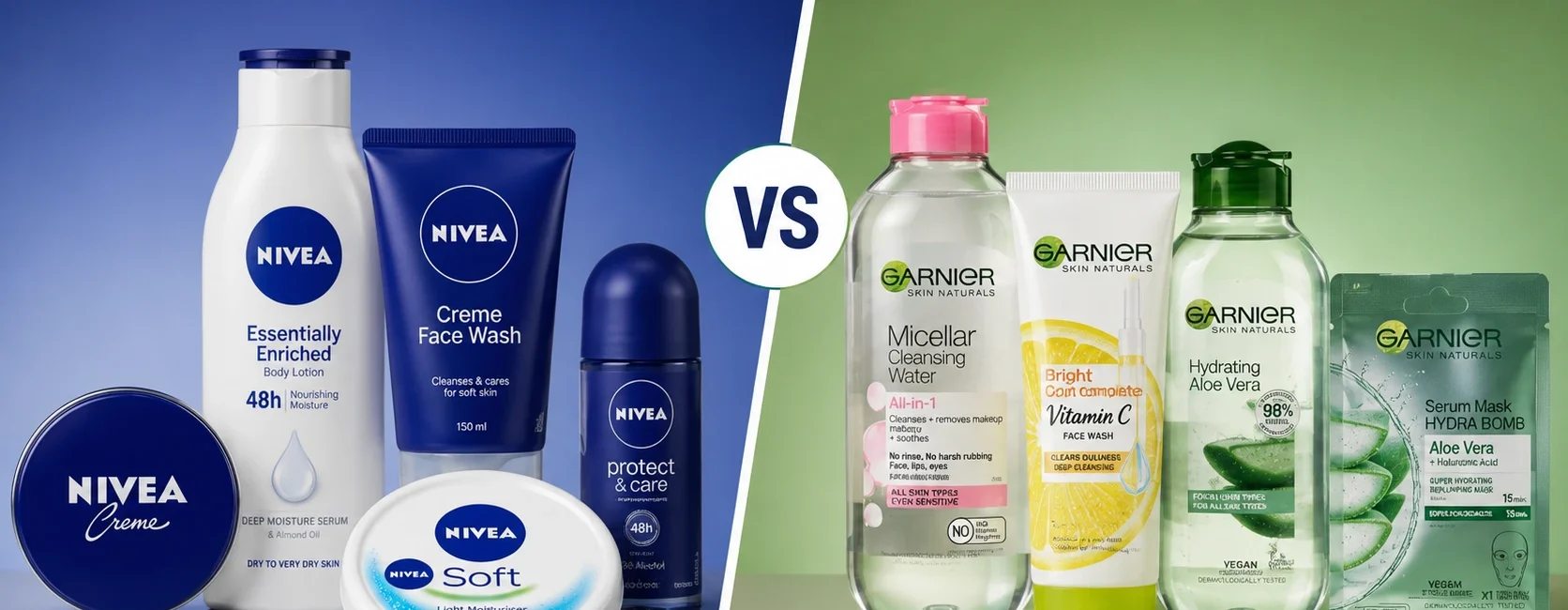
Quick answer: For most complete beginners, Nivea is the safer starting point. Its formulas are simple, fragrance-light, and built around hydration rather than active ingredients, which means a low chance of irritation while you’re still learning what your skin actually needs. Garnier is the better choice if you already know your skin runs oily, dull, or acne-prone, since its lineup leans more heavily on actives like vitamin C and salicylic acid that address specific concerns faster, but with slightly more risk of irritation for true first-timers. Many people end up using both: Nivea for moisturizing, Garnier for cleansing and targeted treatment.
Standing in the drugstore aisle staring at a Nivea blue tin in one hand and a bottle of Garnier Micellar Water in the other is a genuinely common moment for anyone starting skincare for the first time. Both brands are affordable, sold everywhere in the US, and marketed as beginner-friendly, but they’re built around different philosophies, and picking the wrong one for your skin type can mean months of a routine that doesn’t actually work for you. Here’s the real breakdown, not just which brand “wins,” but exactly which products to buy and how to build a routine around them.
The Core Difference: Philosophy, Not Just Products
Nivea, a German brand owned by Beiersdorf, has built its entire reputation around one thing: hydration. Since the original blue tin launched in 1911, the brand’s approach has stayed remarkably consistent: simple, rich formulas focused on moisture and skin barrier support, without a heavy reliance on active ingredients that require careful introduction.
Garnier, a French brand under the L’Oréal group, takes a more targeted, results-driven approach. Its lineup leans into ingredients like vitamin C, niacinamide, and salicylic acid, aimed at specific concerns like dullness, oiliness, and acne, rather than hydration as the default starting point.
Neither philosophy is objectively better. The right one depends entirely on what your skin actually needs on day one.
Nivea vs. Garnier: Side-by-Side
| Nivea | Garnier | |
|---|---|---|
| Core focus | Hydration, barrier support | Targeted concerns (oil, dullness, acne) |
| Formula complexity | Simple, minimal actives | More active ingredients (vitamin C, salicylic acid, niacinamide) |
| Best skin type | Dry, sensitive, normal | Oily, combination, dull, acne-prone |
| Irritation risk for beginners | Low | Slightly higher, due to actives |
| Price range | $5–$15 for most core products | $6–$16 for most core products |
| Where it’s sold | Drugstores, supermarkets nationwide | Drugstores, supermarkets nationwide |
| Standout beginner product | Nivea Creme or Nivea Soft | Garnier Micellar Water |
Nivea’s Best Beginner Products
Nivea Creme (the original blue tin), $5–$13. The product the entire brand was built on. A dense, occlusive moisturizer designed for genuinely dry skin and rough patches; not ideal as a lightweight daily face moisturizer for normal or oily skin, but excellent for hands, elbows, and very dry areas, or as a heavier night cream for dry skin types.
Nivea Soft, roughly $6–$10. A lighter, jojoba-oil-based moisturizer that works well as a daily face and body cream without the heaviness of the original Creme. This is generally the better everyday starting point for beginners with normal to dry skin.
Nivea Q10 Power range, roughly $10–$16. A slightly more targeted line for anyone specifically concerned with fine lines or firmness, though still built around Nivea’s gentle, low-irritation philosophy rather than aggressive actives.
Garnier’s Best Beginner Products
Garnier SkinActive Micellar Cleansing Water, roughly $7–$10. Arguably Garnier’s most beginner-friendly product overall: a no-rinse cleanser that removes makeup, dirt, and excess oil with a cotton pad, genuinely gentle despite Garnier’s more active-forward reputation, and a strong first step for any oily or combination skin routine.
Garnier Vitamin C Brightening Serum, roughly $10–$15. A widely recommended entry point into actives for beginners specifically dealing with dullness or uneven tone, generally well-tolerated but still worth patch-testing before full use, as covered below.
Garnier SkinActive Clearly Brighter or Pure Active lines, roughly $8–$14. Formulated with salicylic acid and niacinamide for oily and acne-prone skin, a reasonable starting point for beginners who already know breakouts are their main concern, though these actives should be introduced gradually rather than all at once.
A Sample Beginner Routine With Each brand
If you have dry, sensitive, or normal skin, start with Nivea:
- Gentle cleanser (a basic, fragrance-free option, morning and night)
- Nivea Soft as your daily moisturizer
- A separate SPF 30+ every morning, since neither brand’s core hydration products typically include sufficient sun protection on their own
If you have oily, dull, or acne-prone skin, start with Garnier:
- Garnier Micellar Water to cleanse morning and night
- Garnier Vitamin C serum in the morning for brightening, or a salicylic acid product at night if breakouts are the main concern (not both at once as a beginner)
- A lightweight, oil-free SPF 30+ every morning
A genuinely common third option: many people end up mixing the two brands rather than picking one exclusively, using Garnier’s micellar water to cleanse and a Nivea moisturizer to hydrate afterward. There’s no rule that your routine has to come from a single brand, and this combination specifically plays to each brand’s actual strength.
The Biggest Mistake Beginners Make With Either brand
Introducing too many active ingredients at once, whether from Garnier, Nivea’s more targeted lines, or mixing in additional products from other brands, is the single most common reason beginners end up with irritation, breakouts, or a routine they give up on within weeks. A basic three-step routine- cleanser, moisturizer, SPF- worn consistently for at least six weeks does more for skin than a complicated ten-step routine abandoned after ten days. If you do want to add a targeted product like a vitamin C serum or a salicylic acid treatment, introduce one new active at a time and wait at least a week before adding another, so you can actually tell what’s working and what isn’t.
Always patch test new active ingredients, particularly anything from Garnier’s vitamin C or salicylic acid lines, by applying a small amount to your inner forearm and waiting 24 to 48 hours before using it on your face. This single habit prevents the vast majority of bad first experiences with active skincare ingredients.
When to Consider Switching or Combining Brands
If you started with Nivea and your skin still feels dull, or you’re noticing more breakouts after a few weeks of consistent use, that’s a reasonable signal to introduce a single Garnier product, likely the micellar water or a mild vitamin C serum, rather than switching brands entirely. If you started with Garnier and find your skin feels tight, dry, or irritated, scaling back to a simpler Nivea moisturizer while reducing how often you use active ingredients is generally the right move before assuming the brand itself is the problem.
If you’re already happy with your current beginner brand and your skin looks and feels good, there’s no need to switch just because a different product is trending—consistency with a routine that’s actually working matters more than brand-hopping.
Building Out Your Routine Beyond These Two Brands
Once your basic three-step routine feels stable, a few additional steps can round things out without overcomplicating what’s already working. A hydrating serum layered under your moisturizer, like our recommended glow serum, is a gentle next addition for anyone wanting more radiance without jumping straight into stronger actives. If you’re layering makeup on top of your new routine, a proper primer suited to your skin type helps everything sit better once your skincare foundation is solid.
And regardless of which brand you build your routine around, thorough makeup and sunscreen removal at the end of the day matters as much as what you put on in the morning; our roundup of the best cleansing balms covers the strongest options for fully removing a full day of product without stripping or irritating a beginner’s still-adjusting skin.
Frequently Asked Questions
Is Nivea or Garnier better for oily skin?
Garnier is generally the better fit for oily skin, thanks to its lighter, more targeted formulas and oil-control ingredients. Nivea’s core moisturizing range tends to feel too rich for genuinely oily skin types.
Is Nivea or Garnier better for sensitive skin?
Nivea is usually the gentler, lower-risk choice for sensitive skin, since its formulas are simpler and rely less on active ingredients that can trigger irritation.
Can I use Nivea and Garnier products together?
Yes, and it’s a genuinely common approach. Using Garnier’s micellar water to cleanse and a Nivea moisturizer to hydrate afterward plays to each brand’s core strength rather than forcing you to choose one exclusively.
Do I need a separate sunscreen with either brand?
Generally yes. Most core Nivea and Garnier moisturizing and treatment products aren’t formulated with sufficient SPF on their own, so a dedicated sunscreen of at least SPF 30 is still necessary every morning regardless of which brand you choose.
What’s the biggest mistake skincare beginners make?
Introducing too many active ingredients at once. A simple, consistent three-step routine- cleanser, moisturizer, SPF- used daily for at least six weeks is more effective than a complicated routine that gets abandoned after a week or two.
Is Garnier vitamin C serum safe for beginners?
Generally yes, and it’s one of the more commonly recommended entry points into active ingredients for beginners specifically dealing with dullness. Still, patch testing on your forearm before applying it to your face is a good habit with any new active product.
Final Thoughts
There’s no universally “better” brand between Nivea and Garnier, only a better fit depending on your specific skin type and how much active ingredient exposure you’re ready for as a beginner. If you’re dealing with dryness or sensitivity, or you simply want the lowest-risk possible starting point, Nivea’s straightforward approach is the safer first step. If you already know oiliness, dullness, or breakouts are your main concern, Garnier’s more targeted lineup will likely get you visible results faster. Either way, the real key to a successful first routine isn’t the brand on the label; it’s picking a simple set of products and actually sticking with them long enough to know if they’re working.