
Kajal eyeliner (also called kohl) is an ultra-soft, creamy eye cosmetic designed specifically for the waterline the inner rim where the eyelid meets the eye that creates a smoky, diffused definition rather than a crisp line. It’s one of the oldest beauty products in human history, and in 2026 it’s fully crossed into mainstream Western beauty, sitting on drugstore and prestige shelves alike between pencil liners and waterproof pens. But kajal isn’t the same product as regular eyeliner, and knowing the difference is exactly what determines whether it works for you or smudges everywhere.
By Rehan Khatri | Fashion & Beauty Writer at RK Fashion Zone.
What Is Kajal Eyeliner?
Kajal, translated into English roughly as “kohl” or “eye kohl,” is a traditional eye cosmetic originally made from natural ingredients including soot, charcoal, ghee, and almond or castor oil. Historically used in Egypt, India, the Middle East, and South Asia for thousands of years, it was applied to the eyes not only for cosmetic enhancement but for its believed cooling, protective, and medicinal properties.
The defining characteristic of kajal is its texture: extremely soft, creamy, and blendable. Unlike pencil eyeliners, which range from firm to soft, kajal is specifically designed to smudge. It glides onto the waterline and lash line with almost no friction and creates an immediate smoky, diffused effect rather than a crisp line. This soft-focus quality is what gives kajal its distinctive depth and warmth, and why the product has remained culturally significant and practically beloved across five millennia.
Modern kajal formulas keep the ultra-creamy, blendable character of the original while adding contemporary benefits: waterproof polymers, long-wear ingredients, ophthalmologist testing for waterline safety, and a far wider shade range than traditional black or charcoal.
Kajal vs. Kohl vs. Surma: What’s the Difference in Naming?
These terms are often used interchangeably, but they aren’t identical. Kohl is the broadest, oldest umbrella term, used across the Middle East, North Africa, and South Asia to describe a fine powder traditionally applied with a stick. Kajal is the South Asian variant of the same idea, the term most commonly used in India, Pakistan, and Bangladesh, and now the name used by most modern Western cosmetic brands for their creamy waterline pencils. Surma is a related but distinct traditional formula, most associated with Pakistan and parts of the Middle East, historically ground from antimony sulfide rather than lead sulfide. Other regional names include al-kahal, tiro, tozali, kwalli, kanmashi, kaadige, and kaatuka, depending on the language and region. In plain English, “kajal” is most simply translated as “kohl” or “eye kohl” a soft, dark eye cosmetic for the waterline.
Modern cosmetic-brand kajal (the kind sold at Sephora, Ulta, CVS, or Target) is a formulated product regulated under cosmetic safety law and is a different product from traditional, imported kohl or surma a distinction that matters for the safety section below.
What Is Kajal Used For?
Kajal serves several distinct purposes depending on where and how it’s applied:
- Waterline definition — the single most common use. Kajal darkens the inner rim of the eye for a deeper, more dramatic look that standard pencil or liquid liner cannot safely achieve in that spot.
- Tightlining — filling the tiny gaps between upper lashes to make them look naturally fuller, with zero visible “line” on the lid.
- Smoky eye definition — applied to the outer lash line and blended for soft, diffused smokiness rather than a graphic edge.
- Eye brightening — a nude or white kajal on the lower inner waterline can make eyes appear larger and more awake, a technique often used to counter tired-looking eyes.
- Traditional and cultural use — in South Asian and Middle Eastern households, kajal is still commonly applied to babies’ and children’s eyes, based on the traditional belief that it protects and cools the eyes, though modern dermatologists advise caution and recommend only ophthalmologist-tested formulas near the eye.
Kajal vs. Regular Eyeliner: Key Differences
Texture. Kajal is extremely soft and creamy; it smudges intentionally. That’s the design, not a flaw. Regular pencil eyeliner ranges from soft to firm, gel liner is semi-firm, and liquid liner sets into an immovable line. Kajal sits at the softest end and cannot create the crisp, sharp lines liquid or gel produces. If it’s precision and a graphic finish you’re after instead, our full liquid eyeliner application guide covers that formula in depth.
Placement. Kajal is designed specifically for the waterline. Regular eyeliners are designed for the outer lash line. Kajal can go on the lash line too, but regular liners are generally not safe on the waterline; the pigments and preservatives in most formulas can cause irritation, redness, or watering on sensitive mucous membrane skin.
Finish vs. longevity. Kajal gives a smoky, diffused finish; regular liner gives precision and graphic definition. Kajal traditionally has lower longevity than waterproof liquid formulas, though modern waterproof kajal formulas have significantly closed this gap.
Contact lens wearers. Kajal is the safer choice for the waterline specifically. The softer texture means less tugging and irritation. Always choose an ophthalmologist-tested formula if you wear contacts.
Is kajal the same as eyeliner? Not exactly. Kajal is technically a type of eyeliner, but it’s a distinct sub-category built for softness and waterline use, not a substitute for pencil, gel, or liquid formulas designed for the lash line.
How to Use Kajal as Eyeliner: 4 Techniques
1. Waterline Application (Kajal on the Lower Lash Line)
This is the technique kajal was designed for and the one that produces the most distinctive, dramatic effect, making the eyes appear larger, deeper, and more defined without visible eyeliner on the outer lid.
Apply the kajal pencil directly to the inner rim of the lower lash line, tracing from the inner corner to the outer corner in a single smooth stroke. Work quickly and don’t press too firmly; the creamy texture deposits pigment with very light pressure. You can repeat on the upper waterline by gently lifting the upper lid slightly to expose the inner rim above the lashes, then tracing similarly.
The effect: The lower waterline darkened with black or dark brown kajal makes the eyes look deeper and more dramatic, while white or nude kajal on the waterline creates the illusion of larger, more wide-awake eyes.
2. Tight-Lining (Kajal on the Upper Waterline)
Tightlining involves applying kajal to the upper waterline, the thin strip of skin just beneath the upper lashes where they emerge from the lid. This technique fills the gaps between lashes to create the impression of naturally thicker, fuller lashes without visible liner on the eyelid.
It’s one of the subtlest and most effective techniques in makeup; the result looks like you were born with remarkable lashes rather than having applied any product at all.
Apply with a gentle dabbing motion rather than a dragging stroke. A waterproof kajal formula is especially important here since this area stays in close contact with the eye surface.
3. Lash Line Application (Smoky Effect)
Apply kajal along the upper and/or lower lash line on the outer lid, then immediately blend with a fingertip, a small smudge brush, or the built-in smudger that many kajal pencils include. The product moves easily in the seconds after application before setting; this is your window for blending.
For a soft, everyday look, blend with a light touch. For a more dramatic smoky eye, press a matching dark eyeshadow over the blended kajal to intensify the effect and extend its wear time.
4. Full Smoky Eye
Combine all three techniques: kajal on both lash lines blended outward, applied to both waterlines, then a coordinating dark eyeshadow layered over the blended area. Kajal in the inner corner brightens; deeper application at the outer corner adds structure.
How to Make Kajal Last Longer
Kajal’s soft texture is both its greatest strength and its biggest longevity challenge. These techniques make a real difference:
Dry the waterline first. Trace the waterline with a clean, dry cotton swab before applying kajal. This removes moisture and oil so the formula adheres longer before migrating.
Set immediately with eyeshadow. Pat a matching dark matte eyeshadow over freshly applied kajal with a flat brush. This locks the creamy formula in place and significantly extends wear time.
Choose a waterproof formula. Modern waterproof kajal using dimethicone and silicone-based polymers outperforms traditional oil-and-wax bases on the waterline, especially important for oily lids or humid climates.
Build in thin layers. Multiple thin applications adhere better than one heavy stroke and reduce the migration that comes from overloading the waterline with too much product at once.
Prime your lid. If you’re combining kajal on the waterline with liner or shadow on the lid itself, a light primer underneath keeps the whole look from sliding by midday. Our eyeshadow primer buying guide breaks down which formulas hold up best.
Best Kajal Eyeliner for the Waterline (2026)
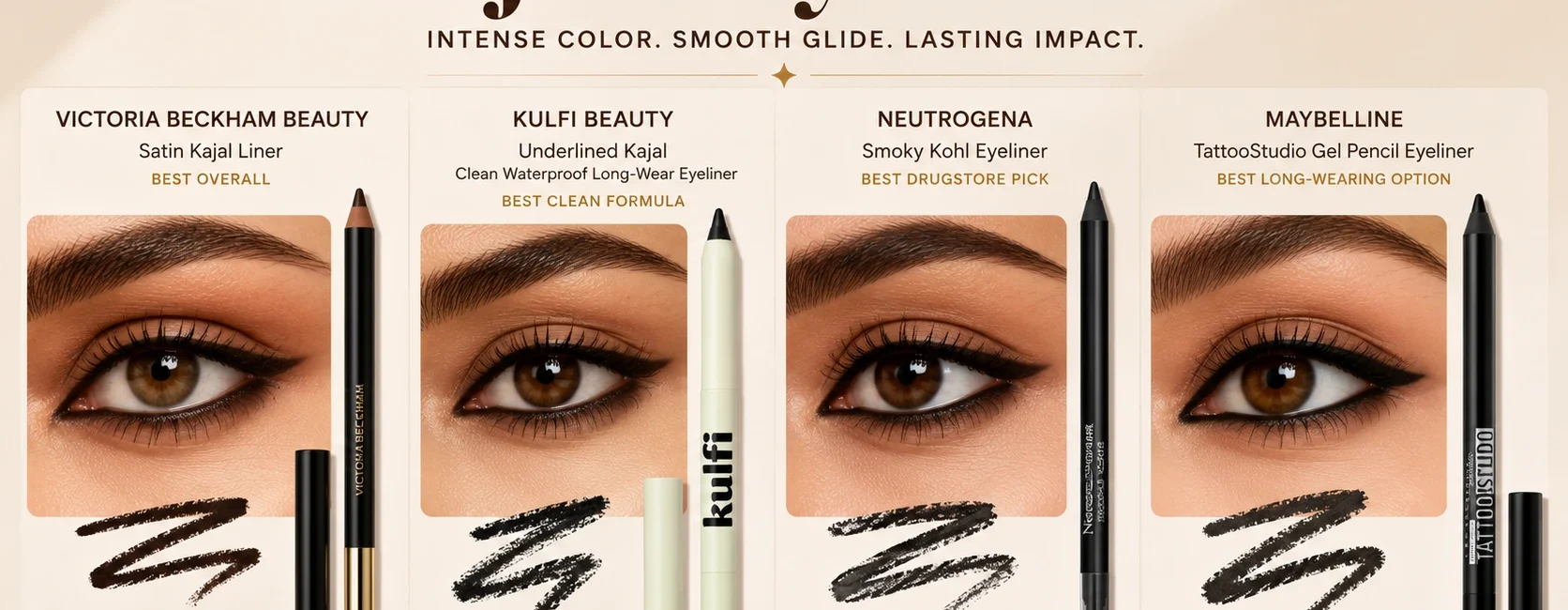
1. Victoria Beckham Beauty Satin Kajal Liner — Best Overall
Price: ~$30 | Shades: 18 shimmer, metallic, and matte options
The most editor-tested and most award-mentioned kajal in recent beauty coverage, and it consistently earns that recognition. The creamy formula glides on smoothly and locks in with waterproof staying power, delivering dramatic eye definition whether worn seamlessly crisp or smudged into a soft, lived-in look ophthalmologist- and dermatologist-tested for safety on the waterline and safe to wear with contacts. Reviewers consistently praise its rich pigment payoff, the built-in smudger, and an impressive shade range that includes both neutrals and statement colours.
Best for: All-over eye use including waterline, tightlining, lash line, and smoked-out looks. The most universally flattering option across skill levels.
2. Kulfi Beauty Underlined Kajal — Best Clean Formula
Price: ~$20 | Shades: Multiple, including both shimmer and matte options
A South Asian-inspired kajal brand that has become a standout in the clean beauty space. The Kulfi Underlined Kajal is described as brown-girl-friendly in beauty press testing, with both black and brown shades showing up genuinely and vibrantly across deeper skin tones an important distinction, since many kohl and kajal formulas are designed primarily around fair complexions.
The formula is vegan, cruelty-free, and waterproof, with a buttery-smooth texture that applies without tugging. Particularly noted for its performance on darker skin tones, where it delivers visible intensity that many competing kajal formulas fail to provide.
Best for: Deeper skin tones, clean beauty shoppers, those wanting visible pigment in both black and brown shades.
3. Neutrogena Smoky Kohl Eyeliner — Best Drugstore Pick
Price: ~$10 | Shades: Black and brown
A consistently pro-approved drugstore kajal that satisfies the three key criteria for waterline eyeliners: long-wearing, waterproof, and non-irritating. Formulated with vitamin E for a smooth, tug-free glide, it delivers highly pigmented colour that can be blended out immediately for a smoky effect or left to set for a more defined look. Widely available at CVS, Walgreens, and Target across the US.
Best for: Budget shoppers, first-time kajal buyers, those with sensitive eyes who want a widely available formula.
4. Maybelline TattooStudio Gel Pencil Eyeliner — Best Long-Wearing Option
Price: ~$10 | Formula: Gel-kajal hybrid
A gel formula with kajal-like blendability and significantly enhanced staying power. Reviewers consistently praise its intense pigment, smooth application, and 36-hour wear claim. For those whose main frustration with traditional kajal is migration on the waterline, this gel-kajal hybrid is the most practical upgrade at a drugstore price.
Best for: Those who love kajal’s look but need maximum waterline longevity, and those with oily eyelids.
Common Kajal Application Mistakes
Migration throughout the day is the most common kajal complaint; fix it by drying your waterline first, setting immediately with eyeshadow, and switching to a waterproof formula if you have oily lids.
Looking too heavy. Start with just the lower waterline or just the upper lash line rather than applying everywhere simultaneously. Build intensity gradually.
Smudging under the eye before setting. Apply a light translucent powder under the eye before kajal application to create a barrier that reduces transfer.
Using the wrong formula near the eye. Not every eyeliner pencil is safe on the waterline. Always check that a formula is specifically labelled for waterline or ophthalmologist-tested use before applying it to the inner rim.
How to Remove Kajal Eyeliner Safely
Because kajal sits on the waterline itself, rather than just the outer lash line, removal needs a gentler approach than a regular face wipe.
- Use a dedicated, gentle eye makeup remover a bi-phase (oil-and-water) formula or a fragrance-free micellar water is ideal for breaking down waterline pigment without excessive rubbing.
- Soak a cotton pad and hold it against closed eyes for a few seconds to let the product loosen before wiping, rather than dragging it off dry.
- Wipe gently outward along the lower waterline, and use a cotton swab dipped in remover for any pigment left in the inner rim specifically.
- Avoid tugging or scrubbing the waterline and surrounding skin are delicate, and aggressive rubbing can cause irritation or contribute to lash loss over time.
- Rinse with clean water afterward if any residue remains, and avoid sleeping in kajal on the waterline as a habit, even with a gentle formula.
Frequently Asked Questions
What is kajal eyeliner?
Kajal is a soft, creamy traditional eye cosmetic, also called kohl, designed to be applied to the waterline and lash line for a smoky, diffused definition. It differs from standard pencil, gel, or liquid eyeliner in both texture and intended placement.
What is the difference between kajal and eyeliner?
Kajal is ultra-soft and made to smudge, designed specifically for safe use on the waterline. Regular eyeliner (pencil, gel, or liquid) is firmer, built for the outer lash line, and generally not intended or safe for waterline application.
Can I use kajal as eyeliner?
Yes, kajal can be applied to the outer lash line for a soft, smoky look, though it won’t create the crisp, defined line that pencil, gel, or liquid eyeliner produce.
Can eyeliner be used as kajal?
Not safely in most cases. Standard eyeliner formulas aren’t tested or formulated for the waterline’s sensitive mucous membrane skin, and using one there can cause irritation, redness, or watering. Stick to a product specifically labelled for waterline or kajal use.
Is kajal safe for the waterline every day?
Generally yes, provided you use an ophthalmologist-tested, waterproof formula and remove it thoroughly each night. Using expired kajal or sharing kajal pencils increases the risk of eye irritation or infection.
What is a kajal pencil made of?
Traditional kajal was made from soot, charcoal, ghee, and natural oils. Modern kajal pencils typically use a wax or silicone base with pigments and skin-conditioning ingredients, often with added waterproofing polymers for longer wear.
Final Thoughts: Is Kajal Right for Your Routine?
Kajal eyeliner occupies a unique and genuinely irreplaceable space in eye makeup; it creates depth, warmth, and natural smokiness that no other product in the eyeliner category can fully replicate. Where liquid liner gives precision and gel liner gives intensity, kajal gives softness, lived-in depth, and a connection to one of the oldest beauty rituals in human history.
For the waterline specifically, kajal is the product of choice, gentler and more flattering than applying standard eyeliner to sensitive mucous membrane skin. For smoky eyes, its blendability makes the look accessible even for beginners. Start with a quality waterproof formula like the Victoria Beckham Satin Kajal or the Kulfi Underlined Kajal, dry your waterline before applying, and set with matching eyeshadow for all-day wear.
If you’re building out a full eye makeup routine beyond kajal, our guides on liquid eyeliner application, gel eyeliner, and the best waterproof eyeliners of 2026 cover the formulas that pair well with kajal for a complete look.


1 Comment
[…] soft kajal eyeliner is useful for this because it moves more easily than a liquid formula. If you want a sharper modern […]