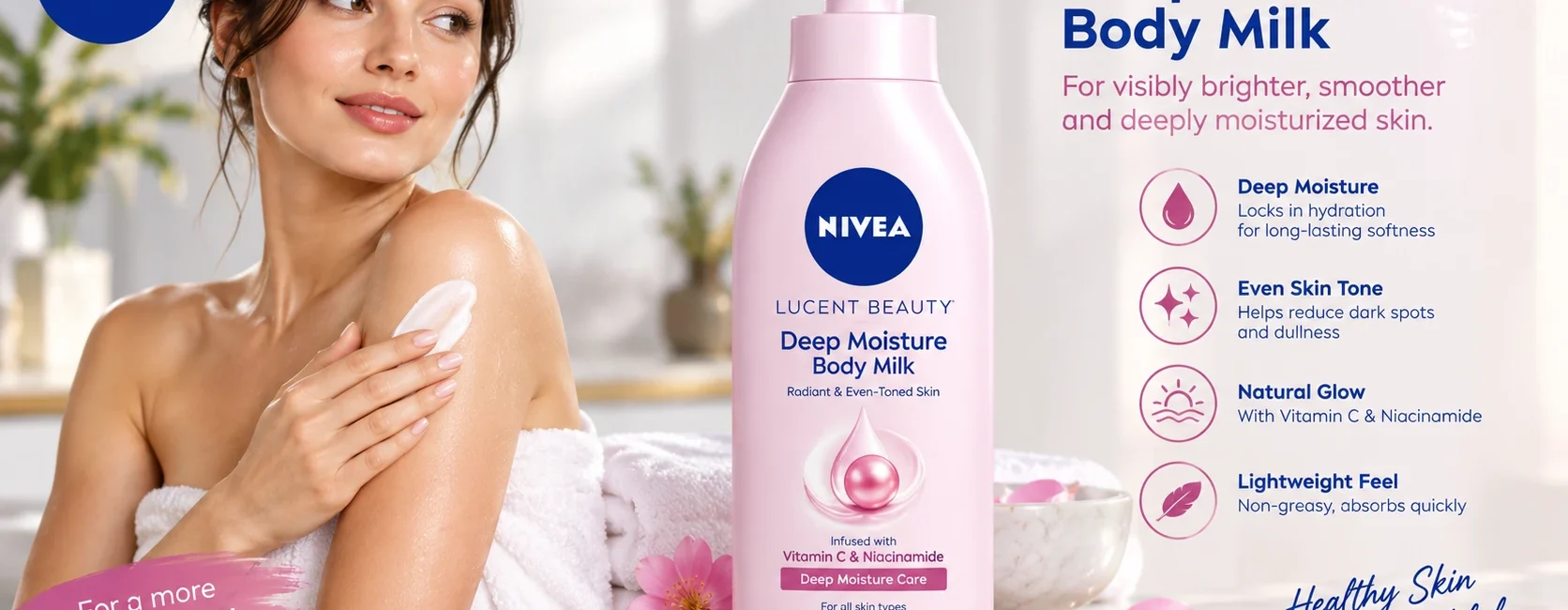
If you’ve gone looking for Nivea Lucent Beauty Deep Moisture Body Milk at a US drugstore, you’ve probably come up empty, and there’s a reason. This isn’t a US Nivea product. It’s part of a serum-style body care line sold by Nivea Japan, and Americans can only get it through importers and marketplace sellers. That changes almost everything about how you should shop for it: what it costs, how to check you’re getting the right version, what’s in the formula, and how it compares with the Nivea lotions on US shelves. This guide covers all of it.
The Short Answer
- What it is: a leave-on body milk (a light lotion) from Nivea Japan’s Lucent Beauty line, aimed at very dry skin, with a rich rose scent.
- Where it’s sold: Japan, and in the US through import retailers and marketplaces such as JapaneseTaste, YesStyle, and eBay.
- What it costs in the US: I found $12.95 for 200 g, $21.68 for 350 g, and $36.47 for 350 g on a marketplace listing, before any shipping or import fees.
- How it differs from US Nivea: it’s a different formula and a different price tier, and its ingredient list includes fragrance, phenoxyethanol, and methylparaben.
- Biggest caveat: there are very few independent English reviews, so most of what’s known comes from the manufacturer’s claims.
What Is Nivea Lucent Beauty Deep Moisture Body Milk
Nivea Lucent Beauty is a “serum body care” line sold in Japan by Nivea-Kao (ニベア花王), and the Deep Moisture body milk is its entry for very dry skin. Kao’s Japanese product pages list it with a release date of August 30, 2025, and a newer release date of August 29, 2026, which accompanies a note that the packaging is being renewed in stages. That means you may see two package designs in circulation, and a different look doesn’t automatically mean a fake.
Key facts from the Japanese listings:
- Type: a leave-on body milk, intended for extremely dry skin.
- Sizes: 200 g and 350 g.
- Scent: a rich, upscale rose fragrance.
- Directions: apply an appropriate amount to the neck, arms, legs, and the rest of the body. The Japanese label also says it can be used on the face.
- Barcodes: retailers list the 200 g size under JAN 4901301454072 and the 350 g size under 4901301454089, which can help you confirm you’re looking at the Deep Moisture type.
The brand’s pitch is “serum for your body”: it positions the formula as bringing face-care-level hydration to the body.
The Three Lucent Beauty Types
The same line comes in three variants, and import listings sometimes mix them up, so it’s worth knowing the differences:
| Type | Main focus | Notable ingredients named by the brand | Scent |
|---|---|---|---|
| Deep Moisture | Deep hydration for very dry skin | Hyaluronic acid, glycerin, glycogen, glyceryl glucoside, glucosamine, plus a “penetrating” hydrolyzed hyaluronic acid | Rich rose |
| Vital Enrich | Plump, firmer-looking skin | Collagen peptide complex: functional peptide, niacinamide, water-soluble collagen, coenzyme Q10 | Chamomile and rose |
| Silk Brightening | Brighter-looking, smooth skin | A stable vitamin C active, described on import sites as helping prevent dark spots and freckles | Not confirmed |
A note on Silk Brightening: in Japan, “whitening” or “brightening” claims on some products are regulated as quasi-drug claims, which aren’t equivalent to what a US product label can say. Don’t assume US rules apply to that wording.
What the Marketing Terms Actually Mean
Beauty marketing language gets translated loosely, so here’s what the Japanese labels say once you read the footnotes:
- “Hyaluronic 4G”: the brand lists hyaluronic acid (as sodium hyaluronate) alongside four ingredients that all begin with “G”: glycerin, glycogen, glyceryl glucoside, and glucosamine. That looks like where the “4G” comes from, though Kao doesn’t spell that out in the pages I read.
- “Penetrating”: the Japanese label footnotes this as reaching the stratum corneum, the outermost layer of skin. It doesn’t mean deep into the body. This is a common convention in Japanese cosmetics labeling.
- “Translucent skin”: the product’s “transparent, glowing skin” language is footnoted as a skin impression created by moisture, not a change in skin tone.
- “Moisture that lasts”: this is a brand claim without a published test in the pages I found.
The Ingredient List, Explained
The full list on Japanese retailer pages for the 200 g and 350 g sizes reads, in English INCI terms: water, glycerin, butylene glycol, isopropyl palmitate, stearyl alcohol, glyceryl stearate citrate, hydrogenated coco-glycerides, diglycerin, dimethicone, sodium hyaluronate, hydrolyzed hyaluronic acid, squalane, glyceryl glucoside, acetyl glucosamine, glycogen, a glyceryl tri-ester of caprylic, capric, myristic, and stearic acids, xanthan gum, gellan gum, cetyl alcohol, sodium citrate, citric acid, phenoxyethanol, methylparaben, and fragrance.
What the main players do:
- Humectants (glycerin, butylene glycol, diglycerin, hyaluronic acids, glucosamine) draw water into the skin’s surface.
- Emollients and occlusives (isopropyl palmitate, squalane, dimethicone, hydrogenated coco-glycerides, the triglyceride) smooth skin and slow water loss.
- Emulsifiers and thickeners (glyceryl stearate citrate, stearyl and cetyl alcohols, xanthan and gellan gums) give it the milky texture.
- Preservatives and fragrance: phenoxyethanol and methylparaben preserve the formula, and “fragrance” gives it the rose scent.
If you’re sensitive to fragrance or you avoid parabens, this formula isn’t for you. Check the label on your bottle, since lists can change, and talk to a doctor if you have eczema or another skin condition, because this is a cosmetic and not a treatment.
How It Compares With Nivea Lotions Sold in the US
US Nivea body lotions are a different line with different ingredients. Here’s how the options stack up by price per 100 ml or 100 g, based on listings I found:
| Product | Size | Price | Approx. per 100 ml / g |
|---|---|---|---|
| NIVEA Essentially Enriched Body Lotion (US) | 16.9 fl oz (500 ml) | $7.97 at H-E-B, $11.99 at Walgreens, $13.99 at Walmart | $1.59 to $2.80 |
| Lucent Beauty Deep Moisture, JapaneseTaste | 200 g | $12.95 | $6.48 |
| Lucent Beauty Deep Moisture, YesStyle | 350 g | $21.68 | $6.19 |
| Lucent Beauty Deep Moisture, eBay | 350 g | $36.47 | $10.42 |
The import costs roughly 2 to 6 times as much per 100 g, before shipping and fees. For context, Nivea’s US Essentially Enriched lotion is marketed with hyaluronic acid and almond oil for dry to very dry skin, with a “72-hour moisture” claim, and the ingredient list on Nivea USA’s site doesn’t include fragrance. The Lucent Beauty list does.
I can’t tell you the import outperforms the US lotion, because I couldn’t find independent testing or enough English-language reviews. If a rose scent and a lighter, “serum-style” feel appeal to you, the premium may be worth it for you. If you mainly want a reliable moisturizer for dry skin, the US lotion is far cheaper.
If you’re weighing how gentle Nivea’s creams are for sensitive skin in general, our comparison of Nivea and Aveeno for sensitive skin is a useful companion read.
Where to Buy It in the US and What to Check
I found three types of sellers:
- Specialty Japanese food and goods importers such as JapaneseTaste, listing the 200 g Deep Moisture at $12.95.
- Asian beauty retailers such as YesStyle, listing the 350 g at $21.68.
- Marketplace sellers on eBay, with the 350 g at $36.47 on one listing.
Before you order:
- Confirm the variant. Look for “Deep Moisture” (ディープモイスチャー), the rose scent, and the barcode numbers above. In one eBay feedback comment on a different Nivea Japan body milk, a buyer reported receiving the wrong scent, so verify the exact variant.
- Compare the landed cost. Shipping from Japan can be free or substantial. On other Nivea Japan items I saw eBay shipping ranging from included to $40. Check shipping and import fees before judging a price.
- Check the seller’s rating and return policy, since returns on imports can be limited or at your expense.
- Expect Japanese labeling. Ingredients and directions may be printed only in Japanese.
- Pay with a method that offers dispute rights.
- Expect two designs. Because Kao is renewing the packaging, an older or newer design doesn’t by itself signal a problem.
How to Use It
Kao’s directions are simple: apply an appropriate amount to your neck, arms, legs, or whole body. A few practical habits, which are general moisturizing advice rather than brand instructions, tend to help:
- Apply after a shower while your skin is still slightly damp.
- Start with a small amount and add more where skin is driest, such as shins and elbows.
- Patch test first if you plan to use it on your face, since the product contains fragrance. The Japanese label says it can be used on the face, but your skin may disagree.
- Don’t apply it to cuts, swollen skin, or eczema flare-ups, and stop if you get irritation.
- Wear sunscreen on exposed skin during the day. It isn’t a sun-protection product.
Who It May Suit, and Who Should Skip It
May be a good fit if:
- You have very dry skin and enjoy a rich rose scent
- You like Japanese serum-style body care and don’t mind paying an import premium
- You’re comfortable with a formula that contains fragrance and parabens
Probably not for you if:
- You’re fragrance-sensitive or avoiding parabens
- You want the lowest price per ounce
- You need the convenience of returns and fast shipping from a US store
- You have a skin condition that needs medical care rather than a cosmetic moisturizer
Frequently Asked Questions
Is Nivea Lucent Beauty sold in US stores?
Not in the places I checked. It’s a Japan-market product, and US buyers get it from import retailers and marketplace sellers.
Is it the same as Nivea body lotion sold in the US?
No. It’s a different line with a different ingredient list and a different price tier. US lotions such as Essentially Enriched have their own formula.
What does “Hyaluronic 4G” mean?
The label pairs hyaluronic acid with four “G” ingredients: glycerin, glycogen, glyceryl glucoside, and glucosamine. That appears to be the source of the name, though the brand’s pages don’t spell it out.
Does it really penetrate deeply?
The Japanese label’s footnote says “penetrating” means reaching the stratum corneum, the outermost layer of skin.
Can I use it on my face?
The Japanese directions say it can be used on the face as well as the body. Because it contains fragrance, patch test first.
Does it contain fragrance and parabens?
The ingredient list on Japanese retailer pages includes fragrance, phenoxyethanol, and methylparaben. Check the bottle you receive.
Which size is the best value?
Based on the prices I found, the 350 g size from YesStyle works out to about $6.19 per 100 g and the 200 g from JapaneseTaste to about $6.48, while a marketplace listing for the 350 g was about $10.42. Shipping and fees change the math.
What are the other Lucent Beauty types?
Vital Enrich (peptides, niacinamide, collagen, and coenzyme Q10, with a chamomile and rose scent) and Silk Brightening (a stable vitamin C), alongside Deep Moisture.
Why does my bottle look different from the photos?
Kao is renewing the packaging in stages, so both designs may be in circulation.