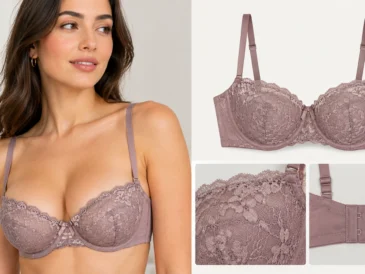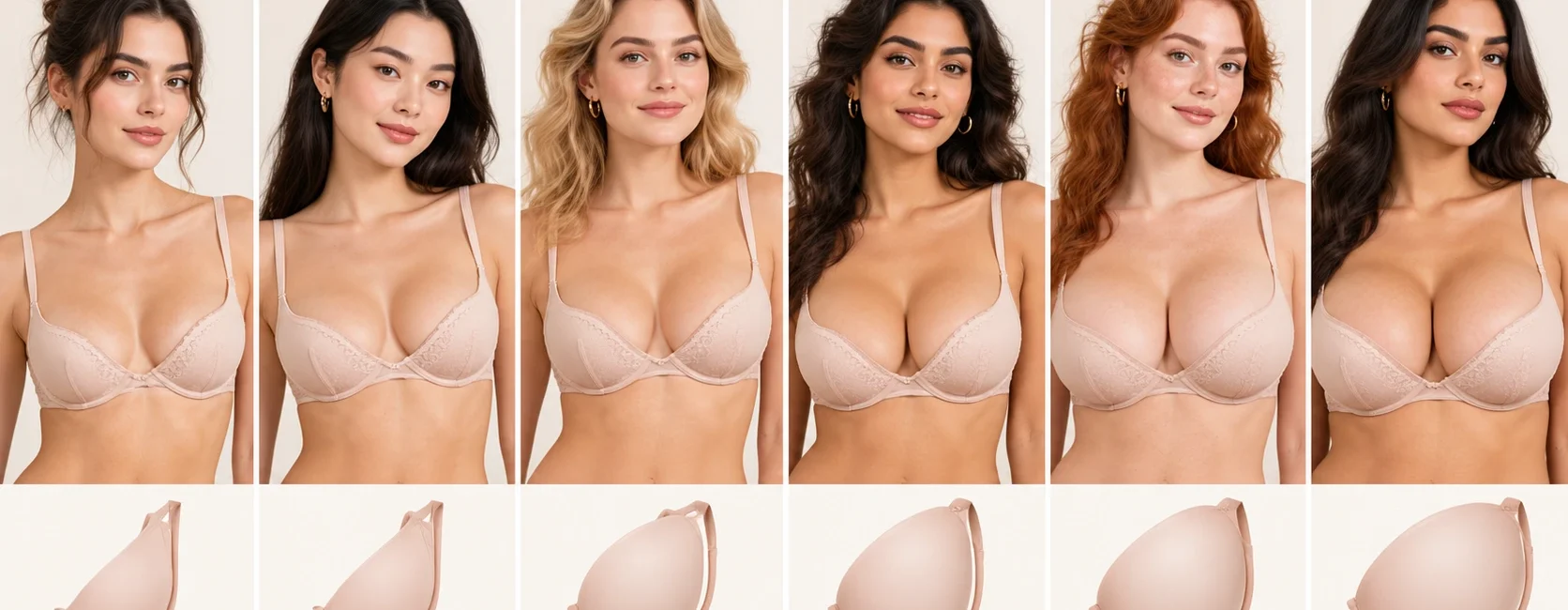
Most people picture cup sizes as a simple ladder: A is small, F is big, and everything in between is a step up. That picture is only half right. A cup letter doesn’t describe a fixed amount of breast volume. It describes a difference, and that difference means something different depending on the band it’s attached to. Once you see that, comparing A, B, C, D, DD/E, and DDD/F becomes much easier, and a lot of confusing sizing advice starts to make sense.
The Short Answer
- A cup size is the difference between your bust measurement and your underbust (band) measurement. Each inch of difference is one cup letter.
- A = 1 inch, B = 2, C = 3, D = 4, DD (or E) = 5, DDD (or F) = 6.
- A, B, C, and D mean the same thing in the US, UK, and EU. From 5 inches up, the labels diverge. The UK F is 7 inches, one step bigger than the F used in the US and EU.
- You can only compare cup sizes fairly when the band size is the same. A 30D and a 40D have the same inch difference but very different cup volumes.
If you want your own numbers rather than a chart, our bra size calculator takes your underbust and bust measurements and returns your size in US, UK, and EU sizing, plus sister sizes.
Cup Sizes A to F at a Glance
| Bust minus underbust | In cm | US label | UK label | EU label |
|---|---|---|---|---|
| Under 1 in | Under 2.5 | AA | AA | AA |
| 1 in | 2.5 | A | A | A |
| 2 in | 5 | B | B | B |
| 3 in | 7.5 | C | C | C |
| 4 in | 10 | D | D | D |
| 5 in | 12.5 | DD (or E) | DD | E |
| 6 in | 15 | DDD (or F) | E | F |
| 7 in | 17.5 | G | F | G |
That last row is the one that surprises people. If you see “F” on a UK label and “F” on a US or EU label, they are not the same cup. The UK F matches a US G. Whenever you shop across regions, compare the inch difference or run the sizes through a converter instead of trusting the letter.
What Each Size Looks Like on the Same Band
To compare cups honestly, hold the band constant. Here is the bust measurement you’d have at each cup, using the same chart our calculator uses (underbust rounded to the nearest even band number):
| Band | A | B | C | D | DD / E | DDD / F |
|---|---|---|---|---|---|---|
| 30 | 31 | 32 | 33 | 34 | 35 | 36 |
| 32 | 33 | 34 | 35 | 36 | 37 | 38 |
| 34 | 35 | 36 | 37 | 38 | 39 | 40 |
| 36 | 37 | 38 | 39 | 40 | 41 | 42 |
| 38 | 39 | 40 | 41 | 42 | 43 | 44 |
| 40 | 41 | 42 | 43 | 44 | 45 | 46 |
Read across any row and you can see the pattern: every step up in cup adds one inch to the bust measurement, no matter the band. That’s the only thing a cup letter guarantees.
The Rule That Makes Every Comparison Make Sense: Cup Size Is Relative
A cup letter describes how much bigger your bust is than your band. It doesn’t describe volume in isolation. A 30D and a 40D both have a 4-inch difference, but the 40D sits on a ribcage ten inches wider, so its cup holds more.
This is why sister sizes exist. When you move down one band and up one cup (or the reverse), the cup volume stays roughly the same. Follow that chain far enough and the letters stop looking intuitive:
| Same cup volume (approximate) | Bust measurement |
|---|---|
| 38A | 39 |
| 36B | 38 |
| 34C | 37 |
| 32D | 36 |
| 30DD (or E) | 35 |
| Same cup volume (approximate) | Bust measurement |
|---|---|
| 40A | 41 |
| 38B | 40 |
| 36C | 39 |
| 34D | 38 |
| 32DD (or E) | 37 |
| 30DDD (or F) | 36 |
Read the second table again. A 30F has roughly the same cup volume as a 36C or a 40A. The letter F sounds enormous, but on a small band it’s an ordinary cup size. Treat these as guides rather than guarantees, since brands cut cups differently and breast shape matters, but the principle holds: never compare cup letters across different bands.
Cup by Cup: What Changes From A to F
Everything below assumes the same band, and the fit notes are general tendencies rather than rules. Shape, projection, and how full your breast tissue is at the top versus the bottom all change how a given size sits.
A Cup (1 inch)
- Bust-band difference: 1 inch, or 2.5 cm.
- Example: on a 34 band, a bust of about 35 inches.
- Common fit challenge: gapping at the top edge of the cup, especially in stiff or deeply cut styles, and straps or strapless bras that slip.
- Styles often worth trying: lightly lined or molded cups, wireless styles, bralettes, and balconette or push-up shapes if you want added fullness.
- Support note: smaller cups still benefit from a proper sports bra for high-impact activity. For styling and fit ideas aimed at this end of the range, see our guide to bra and top styles for a smaller chest.
B Cup (2 inches)
- Bust-band difference: 2 inches, or 5 cm.
- Example: on a 34 band, a bust of about 36 inches.
- Common fit challenge: sitting between A and C, so either slight gapping (cup too big) or slight spilling at the edge (cup too small).
- Styles often worth trying: t-shirt bras, demi cups, plunge styles, and wireless options with some structure.
- Comparison point: the jump from A to B is one inch, the same as every other step. It feels bigger on small frames because one inch is a larger share of a smaller measurement.
C Cup (3 inches)
- Bust-band difference: 3 inches, or 7.5 cm.
- Example: on a 34 band, a bust of about 37 inches.
- Where it sits: with six sizes from A to F, C and D are the middle of the lineup. That’s a position on a chart, not an “average.” There’s no single reliable average, because what counts as typical depends on band size and population.
- Common fit challenge: finding a wire shape that follows your breast root without digging in.
- Styles often worth trying: balconette, full-coverage, and structured wireless bras, depending on how much support you want.
D Cup (4 inches)
- Bust-band difference: 4 inches, or 10 cm.
- Example: on a 34 band, a bust of about 38 inches.
- Common fit challenge: wires that sit on breast tissue instead of the ribcage, and straps doing too much of the work.
- Styles often worth trying: full-coverage and supportive underwire styles, firmer bands, and wider straps.
- Reality check: a D on a 30 band is the same cup volume as a B on a 34 band. On a 40 band, it’s larger. The letter alone tells you very little.
DD or E Cup (5 inches)
- Bust-band difference: 5 inches, or 12.5 cm.
- Labels: DD in the US and UK, E in EU sizing, and written as either DD or E depending on the US brand.
- Common fit challenge: a smaller range of stocked styles in some stores, and cups that need more structure to hold their shape.
- Styles often worth trying: full-cup or full-coverage bras, side support or side boning, and wider band “wings.”
- Common misunderstanding: DD is not “double density,” and it is not “two sizes bigger than D.” It’s the next step after D, one extra inch of difference.
DDD or F Cup (6 inches)
- Bust-band difference: 6 inches, or 15 cm.
- Labels: DDD or F in the US, E in the UK, and F in EU sizing.
- Common fit challenge: matching the band to your ribcage, since some brands stock fewer large cups in smaller bands. Sister sizes help a lot here.
- Styles often worth trying: structured full-cup bras with a firm, wide band, and sports bras with separate cups (encapsulation) for high-impact activity. For support-focused styles, see our guide to bras and support options for a fuller bust.
- Regional catch: if a UK brand lists an F, you’re looking at a 7-inch difference, which is a G in the US.
What Changes as You Move Up the Cup Scale
As the inch difference grows, a few things tend to change in how bras are made:
- More structure. Larger cups usually have more seams, firmer fabrics, or wires to hold their shape.
- A firmer band. The band does most of the supporting, so bigger cups lean on it harder.
- Wider straps and wings. Wider straps spread weight more comfortably, and wider side panels help the band stay level.
- Fewer one-size shortcuts. Stretchy, wireless, pullover styles are easy at small sizes and harder to do well at large ones, which is why styles and brands matter more.
None of this means a smaller cup needs less care. A well-fitted bra helps at every size.
US vs. UK vs. EU: Where A to F Gets Confusing
For A through D, every region agrees. The confusion starts at 5 inches.
| Difference | US | UK | EU |
|---|---|---|---|
| 5 in | DD (or E) | DD | E |
| 6 in | DDD (or F) | E | F |
| 7 in | G | F | G |
| 8 in | H | FF | H |
A few practical takeaways:
- The same letter can be a different cup. A US F is 6 inches and a UK F is 7. If you convert, convert by inch difference rather than by letter.
- US labels aren’t fully standardized. The 5-inch cup shows up as DD or E, and the 6-inch cup as DDD or F, depending on the brand. Check each brand’s size chart.
- Some charts round differently. You may find sites that list E as a 5-to-6-inch range or F as 6-to-7. That’s another reason to treat any chart as a guide and to verify on the brand’s own page.
Myths That Make Cup Sizes Harder Than They Are
- “DD means double D, or two sizes bigger than D.” It’s just the next letter, one inch bigger. Some low-quality pages even claim it stands for “double density,” which isn’t how sizing works.
- “C is average and D is big.” Those labels only mean something relative to a band. A 30D and a 38C can have similar cup volume.
- “Cup sizes end at DD.” They keep going past F into G, H, and beyond. If a store stops at DD, it’s the store’s range that’s limited, not the sizing system.
- “My cup size never changes.” Bodies change. Re-measure every 6 to 12 months and after weight changes, pregnancy, or breastfeeding.
- “If the cup is too small, I just need a bigger band.” A bigger band makes the cup a sister size, which keeps the volume similar. To fit a larger bust, you generally need a bigger cup on the same band.
- “Add 4 inches to my underbust.” This is an outdated shortcut that tends to produce a band that’s too loose. Use your actual underbust measurement, rounded to the nearest even number.
How to Choose Between Two Neighboring Cups
Many people land between two cups, such as C or D. Trying the same band in the cup above and below your calculated size is the fastest way to find the answer. Here’s how to read what you see:
| What you notice in the mirror | What it usually means | What to try |
|---|---|---|
| Breast tissue spills over the top or sides of the cup | The cup is too small | Go up one cup, same band |
| The cup fabric wrinkles or gapes at the top | The cup is too big, or the style doesn’t suit your shape | Go down one cup, or try a different style |
| The center panel (gore) lifts away from your breastbone | The cup is likely too small | Go up one cup |
| The cups fit but the band feels too loose | The band is too big | Sister size: down one band, up one cup |
| The cups fit but the band feels too tight | The band is too small | Sister size: up one band, down one cup |
| The wire sits on breast tissue instead of your ribcage | The cup is too small, or the wire shape doesn’t match you | Go up one cup, or try another style |
If you’ve tried the cup above and the cup below and both feel almost right, the difference is probably style or brand, not size.
Find Your Own Cup Size
You need two measurements: your underbust, measured snugly around your ribcage right under your bust, and your bust, measured loosely around the fullest part with the tape level across your back. The difference between them is your cup. Enter both into the bra size calculator to calculate your band and cup in US, UK, and EU sizing, and to see your sister sizes if the band feels too loose or tight.
For more on how a bra should fit once you have your size, our broader guide to choosing the right bra covers fit, support, and what to look for when you try one on.
Frequently Asked Questions
Which is bigger, D or DD?
DD. It’s one inch more of bust-band difference than D, so at the same band it’s one cup size larger.
Is DD the same as E?
Often, yes. A 5-inch difference is DD in the US and UK and E in EU sizing, and some US brands label it E. Check the brand’s chart.
Is F bigger than DD?
In the US, DDD (or F) is one step above DD, so yes. In the UK, DD is followed by E and then F, so a UK F is two steps above DD.
Is the UK F the same as the US F?
No. A US or EU F is a 6-inch difference. A UK F is a 7-inch difference, which matches a US G.
What is the difference between A, B, C, and D cups?
Each is one inch more than the last: A is 1 inch, B is 2, C is 3, and D is 4, measured as the difference between bust and band.
Is a C cup small, medium, or large?
It depends on the band. A C on a 30 band and a C on a 40 band are very different volumes, so the letter alone doesn’t say whether it’s small or large.
Can two people with the same cup letter have very different cup volumes?
Yes. A 30D and a 40D have the same inch difference but different volumes because the band size is different.
Is a 34B the same as a 32C?
They’re sister sizes with roughly the same cup volume, but the 32C has a tighter band. A 34B and a 36A are also sister sizes.
Why do I wear different sizes in different brands?
There’s no universal sizing standard. Brands cut cups, bands, and fabrics differently, so you may vary by a band or a cup between labels.
How often should I re-measure?
Every 6 to 12 months, and after any major change in weight, pregnancy, breastfeeding, or exercise routine.