
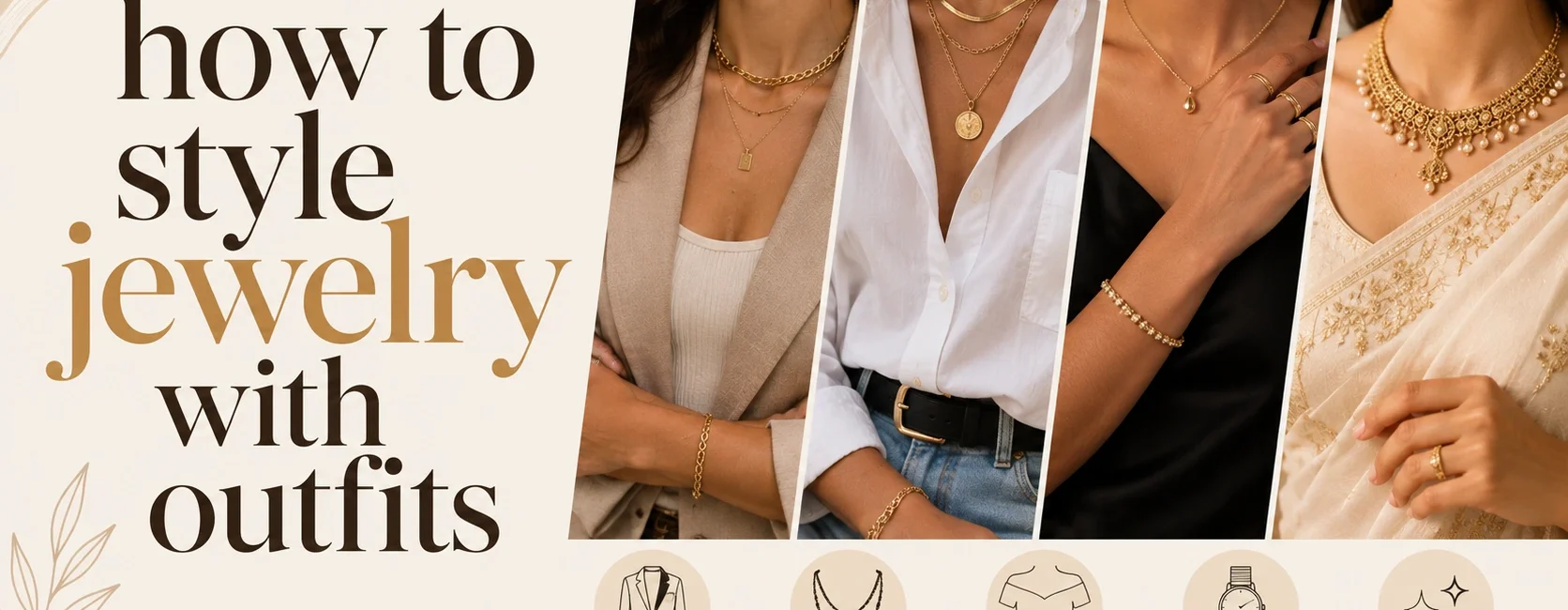
Most jewelry advice boils down to “less is more” or “wear what makes you happy,” which sounds nice but doesn’t actually help when you’re standing in front of a mirror wondering why your outfit still feels unfinished. The truth is, styling jewelry well comes down to a specific set of proportion, color, and occasion rules, the same way styling clothing does. Once you know them, “what jewelry goes with this?” stops being a daily guessing game.
By Rehan Khatri | Fashion & Beauty Writer at RK Fashion Zone.
Rule 1: Let Your Neckline Choose Your Necklace
The single most useful rule in jewelry styling, and the one most people skip entirely, is that your neckline should dictate your necklace, not the other way around.
Crew and high necklines pair best with longer pendant necklaces or layered chains that sit below the collar, since a short choker-length piece competes visually with the neckline itself rather than complementing it.
V-necks and scoop necks are the most versatile and work well with almost any necklace length, though a pendant that echoes the V-shape of the neckline creates an especially polished, intentional look.
Off-the-shoulder and boat necklines are the one place a choker or short collar-length necklace genuinely shines, since the exposed collarbone gives a shorter piece room to sit properly without crowding.
Strapless and halter necklines generally look most finished with statement earrings and minimal or no necklace at all, letting the neckline itself be the focal point rather than competing with a chain.
Rule 2: Mixing Metals Is Not a Mistake Anymore
For years, the rule was to match all your jewelry metals; gold with gold, silver with silver. That rule has genuinely relaxed, and intentional metal-mixing is now one of the most current jewelry trends rather than a faux pas.
The key word is intentional. Mixing works when there’s a clear anchor piece, like a watch or a signature ring, that ties the tones together, or when the mix feels deliberate rather than accidental (a gold necklace with silver earrings and a mixed-metal bracelet reads as curated; three completely random uncoordinated pieces read as messy). If you’re new to mixing metals, start small: one mixed-metal piece, like a two-tone bracelet, is an easier entry point than mixing across your entire look at once.
When to still stick to one metal tone: for formal or professional settings, or when your outfit already has a lot going on visually (bold prints, multiple textures), matching metals keeps the overall look cleaner and more intentional.
Rule 3: Layering Necklaces Without Looking Cluttered
Layered necklaces are one of the most popular jewelry trends of the past several years, and there’s a real formula behind the ones that look effortless rather than tangled.
Vary the lengths, always. Three necklaces at the same length will tangle and visually compete. A true layered look uses at least a few centimeters of length difference between each piece, typically a shorter choker or collar piece, a mid-length pendant, and a longer chain.
Vary the weight and texture, not just the length. A delicate chain, a slightly thicker link chain, and one pendant piece create visual interest through contrast rather than three similar-weight pieces that blur together.
Two to three pieces is the sweet spot. More than that starts to look cluttered rather than intentional for most everyday outfits, though four or five ultra-delicate chains can work as a specific, more maximalist styling choice for going-out looks.
Rule 4: Match Jewelry Weight to Outfit Weight
This is the rule that solves the most common styling mistake: dainty jewelry disappearing under a bold outfit, or heavy statement pieces overwhelming a simple one.
Bold, patterned, or textured outfits (a graphic tee, a printed dress, chunky knitwear) call for simpler jewelry: a single delicate necklace, small studs, one thin ring, so the jewelry supports the outfit rather than competing with it.
Simple, solid-colored, minimal outfits are exactly where statement jewelry gets to do its job. A bold cuff, oversized earrings, or a chunky chain necklace becomes the focal point precisely because nothing else in the outfit is competing for attention.
If you’re building an outfit around a simpler base specifically to let jewelry stand out, our guide to everyday outfit ideas covers several formulas built around exactly this kind of clean, adaptable foundation.
Jewelry with Outfits Type
With denim and casual wear. Casual outfits handle more playful, layered jewelry well; think stacked bracelets, a few thin rings, and a mid-length pendant. Denim’s inherently casual texture also pairs surprisingly well with mixed metals, since the relaxed fabric softens any formality the jewelry might otherwise add. If you’re building a denim-based outfit specifically, our guide to the brown denim trend pairs naturally with warmer-toned gold jewelry for a cohesive, earthy palette.
With oversized tops and hoodies. Loose, oversized silhouettes actually benefit from jewelry doing some of the definition work that the outfit’s proportions aren’t providing. A longer pendant necklace that falls below an oversized tee’s neckline, or stacked bracelets peeking out from a rolled hoodie sleeve, adds a finished touch without disrupting the relaxed fit. Our guides to styling oversized tees and styling oversized hoodies both cover the proportion principles that jewelry placement should work alongside, not against.
With dresses and skirts. The neckline rule above matters most here, since dresses and skirts typically involve the most necklines to consider. A fitted midi dress with a defined waist often looks most polished with a single statement necklace or earrings, not both at once, while a flowier silhouette can handle slightly more layering. Our guide to different skirt styles is a useful reference for matching jewelry weight to a specific skirt silhouette, since an A-line midi and a mini skirt call for genuinely different jewelry choices.
With evening and formal wear. This is where statement jewelry earns its name. A single dramatic piece, a bold necklace, oversized earrings, or a striking cuff, paired with an otherwise simple silhouette reads as far more intentional than multiple competing statement pieces at once. Our breakdown of styling a mermaid silhouette dress covers how jewelry placement interacts with a more dramatic, body-conscious formal silhouette specifically.
With fusion and occasion wear. Indo-Western and fusion outfits often call for a different jewelry approach entirely, frequently layering traditional statement pieces (like jhumkas, kundan sets, or layered bangles) with more contemporary silhouettes. Our guide to Indo-Western dressing covers how these pairings work across different event formalities, from a daytime mehndi to an evening cocktail look.
Building a Jewelry Wardrobe That Actually Works With Your Clothes
Rather than buying jewelry piece by piece as trends catch your eye, building around a small set of foundational pieces makes daily styling significantly easier:
- One everyday pendant necklace in a mid-length that works across necklines
- One statement necklace for elevated or evening looks.
- A set of stud earrings for everyday wear, plus one pair of statement earrings for going out
- Two to three stackable rings in a metal tone that matches most of your other jewelry
- One or two bracelets that can be worn alone or stacked together
- One signature piece, a distinctive ring, pendant, or bracelet you reach for regardless of outfit, that becomes a recognizable part of your personal style.
For a closer look at specific bracelet styles worth having in this kind of foundational rotation, our guide to bracelet types to keep in your collection breaks down which styles are worth the investment. And if you’re drawn to a specific luxury piece as your signature item, our breakdown of the Van Cleef bracelet is worth a look for anyone considering that kind of long-term investment piece.
Common Jewelry Styling Mistakes to Avoid
Matching jewelry to your outfit color instead of your skin tone. Jewelry should generally complement your complexion first; warmer skin tones tend to suit gold and warmer metals, cooler tones often suit silver and platinum, though this is a starting guideline, not a rule, and personal preference matters most.
Wearing too many statement pieces at once. A statement necklace and statement earrings together usually compete rather than complement. Pick one focal point per outfit.
Ignoring proportion relative to your outfit’s neckline and silhouette, covered fully above, but worth repeating: this single adjustment fixes more “something feels off” moments than any other jewelry decision.
Forgetting jewelry as part of the whole look, not an afterthought. Choosing jewelry after an outfit is already fully decided often leads to grabbing whatever’s closest rather than what actually complements the look. Building the habit of considering jewelry alongside the outfit itself, not after, leads to more cohesive results.
Frequently Asked Questions
Is it OK to mix gold and silver jewelry?
Yes, mixing metals is now a widely accepted and current styling choice, as long as it looks intentional rather than accidental. An anchor piece, like a two-tone watch or bracelet, helps tie mixed metals together cohesively.
How many pieces of jewelry is too many?
For most everyday outfits, two to three pieces total (for example, a necklace, earrings, and one ring or bracelet) is the general sweet spot. More can work for a deliberately maximalist evening look, but risks looking cluttered for daytime wear.
Should jewelry match my outfit or my skin tone?
Skin tone is generally the more reliable starting point, since it affects how flattering a metal tone looks regardless of the outfit. From there, adjust for the occasion and the outfit’s overall formality and color palette.
What jewelry works best with a simple, minimal outfit?
Simple outfits are the ideal canvas for statement jewelry, a bold necklace, oversized earrings, or a chunky bracelet, since there’s no competing print or texture for the jewelry to fight against.
Can I wear the same jewelry with casual and formal outfits?
Some pieces genuinely transition well, particularly simple gold or silver studs and a mid-length pendant necklace, but true statement pieces generally work better reserved for the formality level they were designed for.
Final Thoughts
Styling jewelry with outfits isn’t about following a single rigid rule; it’s about understanding a handful of proportion and pairing principles well enough to make quick, confident decisions every time you get dressed. Let your neckline guide your necklace choice, match jewelry weight to outfit weight, and build a small foundational collection you can mix and match rather than buying reactively. Once those habits click, jewelry stops being an afterthought and starts doing what it’s actually meant to do: finishing the outfit.


4 Comments
[…] feel intentional. For anyone looking to build out a similar accessory rotation, our guide to styling jewelry with different outfits and our breakdown of the bracelet types worth having in your collection are great places to […]
[…] you’re working out how to balance pearl earrings against other pieces in an outfit, our guide to styling jewelry with different outfits covers proportion, metal mixing, and when to let one piece carry the look. And if you’re building […]
[…] working out how bangles fit into your broader jewelry choices for a specific outfit, our guide to styling jewelry with different looks covers proportion and balance principles that apply directly to bangle stacking. And if you’re […]
[…] building out how a statement gold piece fits into a broader jewelry collection, our guide to styling jewelry with different outfits covers proportion and pairing principles that apply directly to a bolder, sculptural gold piece. […]