Pearl earrings have quietly become one of the most versatile pieces in modern jewelry. They’re no longer the formal-occasion-only accessory they were a generation ago; today’s designs range from barely-there minimalist studs you can wear to work every day to sculptural baroque drops that carry an entire outfit on their own. If you’re building a collection or just trying to figure out which style actually suits you, here are ten pearl earring styles worth knowing, plus how to choose and care for them.
1. Classic Pearl Studs
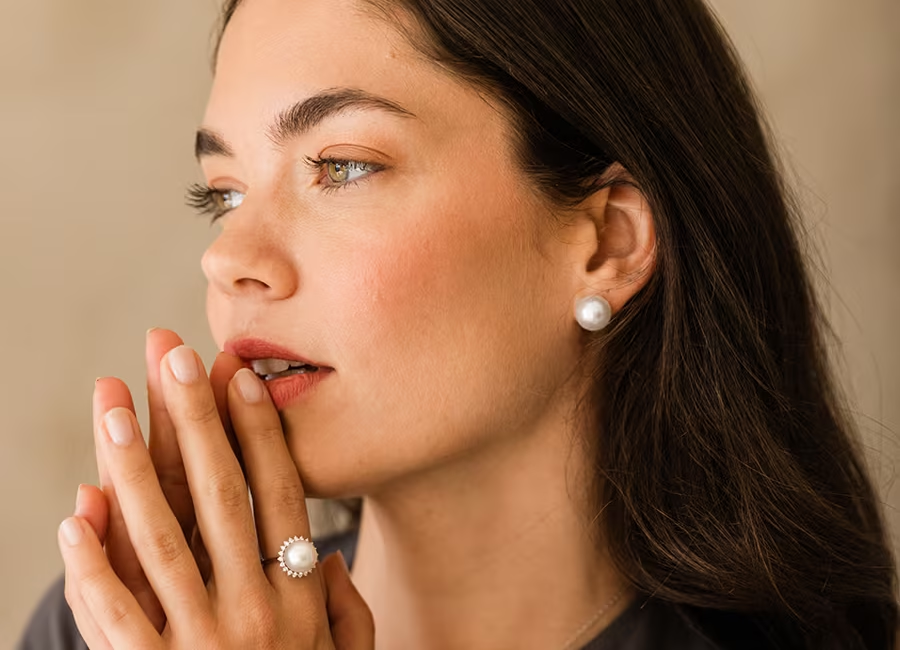
The single most versatile pearl earring, and the one most worth owning if you’re starting from scratch. A simple round pearl on a post setting works with virtually everything: tailored workwear, jeans and a sweater, a cocktail dress. Because studs are so understated, they also pair beautifully with bolder necklaces without creating that stiff, over-matched look a full pearl set can produce.
Best for: Everyday wear, office settings, anyone building a jewelry collection from the ground up.
2. Baroque Pearl Drops
Baroque pearls are irregular and asymmetrical rather than perfectly round, and they’ve moved from niche to mainstream in current collections. Their appeal is exactly their imperfection; no two baroque pearls are identical, so every pair is one of a kind. They tend to read as more modern and less traditional than round pearls, which is precisely why designers have leaned into them so heavily.
Best for: Anyone who finds classic pearls too formal or traditional, and anyone wanting something that doesn’t look mass-produced.
3. Pearl Hoop Earrings
Hoops with pearls set along the band, or a single pearl suspended within a slim hoop, blend the everyday ease of a hoop with a pearl’s polish. Slim pearl hoops in particular have become a staple in the minimalist-luxury direction dominating daily jewelry right now, understated enough for constant wear, but more interesting than a plain metal hoop.
Best for: Daily wear, anyone who already lives in hoops and wants an elevated version.
4. Mismatched Pearl Earrings
Asymmetry is one of the strongest current trends in pearl earrings. A longer drop on one ear paired with a smaller stud on the other, or two different pearl shapes worn together, creates a deliberately unbalanced look that feels experimental rather than sloppy when done well.
Best for: Anyone comfortable with a more fashion-forward, less traditional approach to jewelry.
5. Pearl and Metal Mixed-Material Designs
Some of the most interesting current designs pair soft pearls with high-polish metal, geometric lines, or architectural settings. The contrast between the pearl’s organic softness and a sharp, structural setting creates visual tension that reads as contemporary rather than delicate. These designs can lean edgy or industrial depending on the setting.
Best for: Breaking pearls out of their “soft and traditional” reputation entirely.
6. Tahitian Pearl Earrings
Tahitian pearls are naturally dark, grown in the lagoons of French Polynesia, and come in deep greens, greys, purples, and the famous peacock overtone. A Tahitian drop earring immediately dismantles any assumption that pearls are old-fashioned; the iridescent color shift, depending on lighting, gives them a depth that lighter pearls don’t have.
Best for: Making a statement, evening wear, anyone drawn to unconventional color in jewelry.
7. Pearl Threader Earrings
Threaders pass a fine chain through the earlobe, letting a pearl hang at an adjustable length. They’re delicate, modern, and create movement in a way that rigid drops don’t. This style works especially well for anyone who wants length without the weight or visual heaviness of a large statement drop.
Best for: A modern, minimal look with some movement and length.
8. Oversized Statement Pearl Drops
On the opposite end from minimalist studs, oversized pearl drops, often featuring baroque or South Sea pearls in architectural settings, are designed to carry a look on their own. When you’re wearing a pair like this, you generally don’t need additional accessories; the earrings are the styling decision.
Best for: Events, evening wear, and anchoring an otherwise simple outfit.
9. Pearl Huggie Earrings
Huggies are small hoops that sit close to the earlobe, and pearl versions offer the polish of a pearl with the security and comfort of a snug-fitting hoop. They’re particularly practical for people who want to leave earrings in constantly, and they layer well if you have multiple piercings.
Best for: Everyday, low-maintenance wear and ear stacking.
10. Pearl Ear Cuffs and Climbers
Cuffs wrap the outer ear, and climbers trace upward along the lobe, both offering a way to wear pearls that doesn’t involve a traditional drop or stud at all. They’re a genuinely modern reinterpretation of pearl jewelry and work well layered with simpler studs in a second piercing.
Best for: Anyone wanting a directional, contemporary take on pearls.
Understanding Pearl Types Before You Buy
Knowing what you’re actually looking at helps enormously when comparing prices:
- Freshwater pearls are the most widely available and most affordable type, grown in lakes and rivers. They come in round, oval, drop, and baroque shapes, with natural colors ranging from white to pink, lavender, and peach. For everyday earrings, these offer genuine elegance without a significant investment.
- Akoya pearls are saltwater pearls grown primarily off Japan and China, known for a brilliant, mirror-like lustre and near-perfect round shape. They’re the classic benchmark for refined pearl jewelry.
- South Sea pearls are the largest commercially available pearls, grown in Australia, the Philippines, and Indonesia, with a satiny sheen and colors from creamy white to deep gold. These are genuine investment pieces rather than everyday wear.
- Tahitian pearls are the naturally dark variety described above, from French Polynesia.
- Baroque pearls aren’t a separate species but a shape category of irregular pearls that can occur across any of the above types. Notably, fewer than 10% of any pearl harvest achieves a perfectly round shape, which is part of why baroque pieces have become both widely available and increasingly desirable.
How to Choose Pearl Earrings for Your Face Shape
These are starting points rather than rules, but a few general principles help:
- Round faces often look balanced with longer drops, threaders, or elongated designs that add vertical length.
- Oval faces tend to have the most flexibility and can carry almost any style, from studs to oversized drops.
- Square faces are often softened by rounder pearl shapes and curved settings rather than sharply geometric ones.
- Heart-shaped faces frequently pair well with drops that widen slightly toward the bottom, balancing a narrower chin.
Styling Pearl Earrings Without Looking Dated
The old rule of wearing a matched pearl set — necklace, earrings, bracelet all coordinated is largely what gave pearls their dated reputation. Current styling moves in the opposite direction: pearl studs paired with a chunky chain necklace, baroque drops worn with mixed metals, or pearls layered alongside completely different materials. The contrast is what makes them read as modern.
If you’re working out how to balance pearl earrings against other pieces in an outfit, our guide to styling jewelry with different outfits covers proportion, metal mixing, and when to let one piece carry the look. And if you’re building out a broader collection, our breakdown of bracelet styles worth owning pairs naturally with pearl earrings for everyday layering.
Pearl earrings also work particularly well with structured or minimal clothing; a simple pair of studs against a tailored shirt or a well-fitted pair of dark wash jeans creates that intentional, quietly polished look without effort. For more dramatic occasions, statement pearl drops complement fitted silhouettes beautifully; our guide to the mermaid dress silhouette covers a shape that pairs especially well with a bold earring when the neckline is kept simple.
Caring for Pearl Earrings
Pearls are organic and softer than gemstones, which means they need more care than most jewelry:
- Put pearls on last when getting ready, after perfume, hairspray, and lotion, since these products can dull a pearl’s lustre over time.
- Wipe them gently with a soft cloth after wearing to remove skin oils and residue before storing.
- Never use ultrasonic cleaners or harsh chemicals, which can damage the pearl’s surface permanently.
- Store them separately from other jewelry, ideally in a soft pouch; pearls scratch easily against harder metals and stones.
- Avoid storing them in completely airtight containers long-term, since pearls benefit from some ambient moisture to prevent drying and cracking.
Frequently Asked Questions
Are pearl earrings still in style?
Yes, pearls have had a significant resurgence, with both minimalist studs and sculptural baroque designs appearing widely in current collections. The modern approach is styling them against contrasting materials rather than in matched sets.
What’s the difference between freshwater and Akoya pearls?
Freshwater pearls are grown in lakes and rivers, are more affordable, and come in varied shapes and natural colors. Akoya pearls are saltwater pearls known for a brilliant, mirror-like lustre and near-perfect round shape, positioned as the classic refined option.
Why are baroque pearls so popular right now?
Their irregular, asymmetrical shapes mean no two are identical, which appeals to buyers wanting something genuinely unique rather than mass-produced. They also read as more modern and less formal than perfectly round pearls.
What pearl earrings are best for everyday wear?
Classic studs, slim pearl hoops, and huggies are the most practical everyday options, understated enough to wear constantly and easy to pair with other jewelry.
How do I stop pearls from losing their shine?
Apply perfume, hairspray, and lotion before putting pearls on, wipe them with a soft cloth after each wear, and store them separately from harder jewelry in a soft pouch.
Can I wear pearl earrings with gold and silver together?
Yes, mixing metals is a current styling direction rather than a mistake, and pearls work well as a neutral that bridges different metal tones in a layered look.