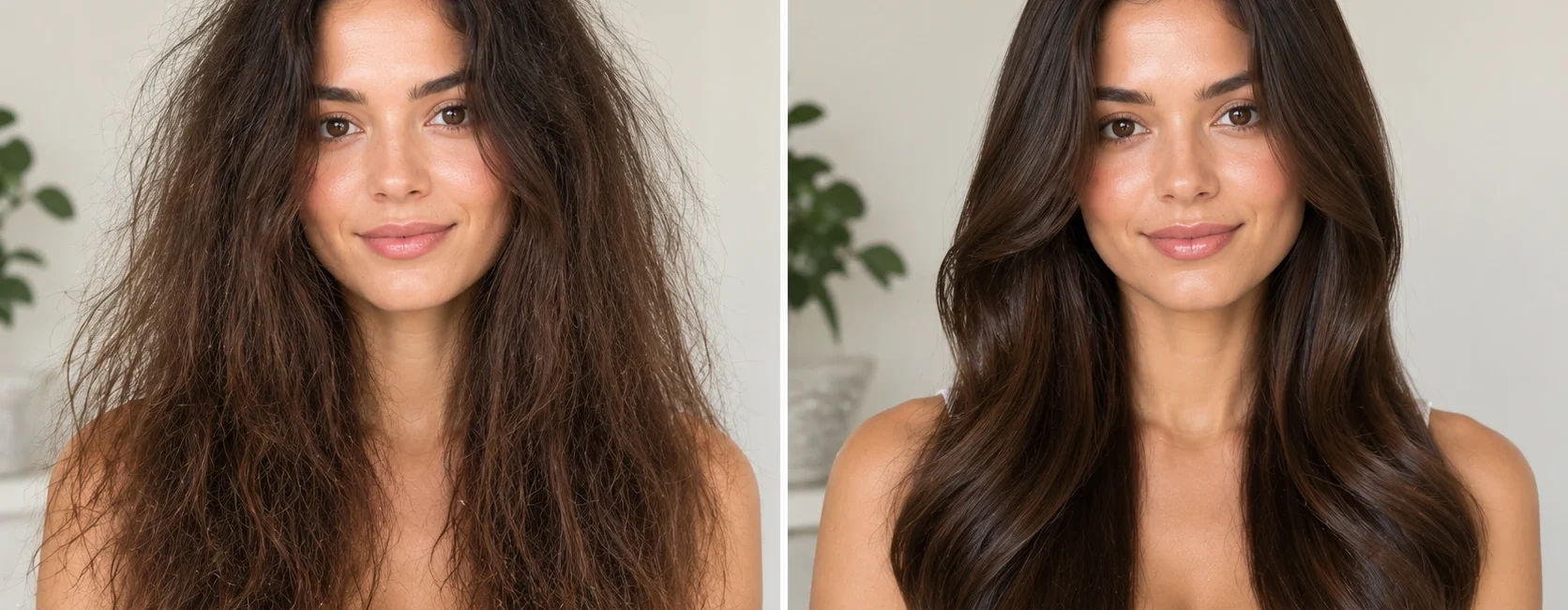
The fastest way to fix frizzy hair right now is to smooth a small amount of leave-in conditioner, serum, or hair oil over damp or dry hair with your palms, working from mid-lengths to ends. But if frizz keeps coming back, the real fix isn’t a product; it’s addressing why your hair’s cuticle keeps lifting in the first place. This guide covers both: what to do about frizz today, and what to change so it stops being a daily fight.
Why Is Your Hair Frizzy? (The Real Cause)
Frizz happens when the outer layer of your hair, the cuticle, made of overlapping scales like shingles on a roof, lifts instead of lying flat. When those scales lift, individual strands separate from each other instead of moving together, which is what creates that fuzzy, uneven texture instead of smooth, defined hair.
Humidity and the Hair Cuticle
Hair is hygroscopic, meaning it naturally absorbs moisture from the air around it. On a humid day, there’s more water vapor available, and dry or already-lifted hair pulls that moisture in unevenly. The water disrupts the hydrogen bonds inside your hair’s protein structure, causing strands to swell and the cuticle to lift further, which is exactly why hair that was smooth in the morning can turn frizzy within minutes of walking outside on a humid day. This is also why blow-drying or flat-ironing hair straight doesn’t hold up in humidity: heat temporarily resets those hydrogen bonds into a smooth shape, but humidity breaks and reforms them again in a more chaotic pattern.
Dryness, Damage, and Porosity
The drier and more porous your hair is, the more aggressively it seeks out moisture from the air, and the more frizz-prone it becomes. Porosity, how easily your hair absorbs and retains moisture, increases with damage from heat styling, chemical processing (coloring, bleaching, relaxing), and mechanical friction from rough towel-drying or brushing. Naturally curly and coily hair is also more prone to frizz structurally, since its bends and curves expose more of the cuticle’s surface area, and scalp oils have a harder time traveling down a coiled strand compared to a straight one.
How to Fix Frizzy Hair Right Now (Quick Fixes)
If you’re dealing with frizz you already have and need a fast fix:
- Smooth on a small amount of leave-in conditioner, serum, or lightweight oil. Rub it between your palms first, then smooth it over the mid-lengths and ends; avoid the roots unless your hair is very dry, since product too close to the scalp can look greasy fast.
- Use a small amount of water to reactivate product. If your hair looks dry and frizzy rather than product-starved, lightly dampening your hands with water before smoothing through can help redistribute moisture without needing more product.
- Avoid re-touching or over-brushing throughout the day. Constant touching and brushing disrupts the cuticle further and can make frizz worse rather than better; smooth once and leave it alone.
- Use a boar-bristle or wide-tooth approach instead of a fine comb if you need to redistribute product, since fine combing can rough up the cuticle further.
- Try a quick low bun, braid, or half-up style if the frizz is more than a touch-up can handle. This isn’t giving up; it’s a legitimate fast fix that also protects your ends from further friction for the rest of the day.
These fixes manage the frizz you have; they don’t address why it happened, which is where long-term changes come in.
How to Fix Frizzy Hair Long-Term (Prevention)
Washing and Conditioning Habits
Washing with hot water strips more natural oil from your hair and scalp, which increases dryness and, over time, frizz. Lukewarm to cool water is gentler on the cuticle. Conditioner isn’t optional for frizz-prone hair: applying it from mid-lengths to ends every wash, and using a deeper conditioning treatment once or twice a week if your hair is dry or damaged, directly targets the moisture imbalance that drives frizz.
Drying Technique
Rubbing hair vigorously with a regular terry towel roughs up the cuticle through friction, which is counterproductive if frizz is your concern. Blotting or gently squeezing water out with a microfiber towel or an old cotton T-shirt causes less friction and less cuticle disruption than a standard towel. If you blow-dry, using a lower heat setting with a diffuser (for curly/wavy hair) or smoothing brush (for straight hair), combined with a heat protectant, reduces the additional damage that compounds frizz over time.
Heat Styling
Every pass of a flat iron or curling wand without a heat protectant increases cuticle damage, which increases porosity, which increases future frizz; it’s a compounding cycle. If you heat style regularly, a heat protectant applied to damp or dry hair before styling isn’t optional if frizz reduction is a goal, and reducing overall heat frequency where possible gives your cuticle a chance to recover.
Overnight Care
Cotton pillowcases create more friction against hair overnight than smoother fabrics, roughing up the cuticle while you sleep. Switching to a silk or satin pillowcase, or loosely wrapping hair in a silk/satin scarf or bonnet, reduces that friction significantly. For longer hair, loosely braiding hair before bed (not tight braiding, as it can create its own breakage) helps prevent overnight tangling and friction; for curly and coily hair specifically, gently gathering hair into a loose “pineapple” on top of the head before bed helps preserve curl shape and reduces the flattening and frizzing that happens from sleeping on loose curls directly.
How to Fix Frizzy Hair by Hair Type
Frizz shows up differently across textures, so the most effective fix isn’t identical for everyone.
Straight Hair
Straight hair tends to show frizz as flyaways and a general lack of smoothness rather than texture change. Lightweight leave-ins or serums (heavier products can weigh straight hair down and look greasy) plus a smoothing brush during blow-drying tend to work well here.
Wavy Hair
Wavy hair often frizzes at the roots and mid-lengths while the ends stay relatively smooth. A lightweight curl cream or mousse applied to damp hair, combined with air-drying or diffusing rather than rough towel-drying, helps waves clump together instead of separating into frizz.
Curly Hair
Curly hair is structurally more prone to frizz due to how much cuticle surface area is exposed along the curl’s bends. Richer leave-in conditioners and curl creams, applied to soaking-wet hair (the “wet” application many curl routines emphasize helps seal in more moisture before the hair starts to dry), tend to perform better than lightweight products here.
Coily Hair
Coily hair typically needs the most moisture-intensive routine, since scalp oil has the farthest distance to travel down a tightly coiled strand. Heavier leave-ins, creams, and sealing oils, along with protective styling and minimizing manipulation, help retain moisture and reduce frizz and breakage.
Fine Hair
Fine hair frizzes easily but also weighs down easily, so the balance is tricky; lightweight, targeted application (avoiding roots, focusing on ends) prevents both frizz and limpness.
Thick/Coarse Hair
Thick and coarse hair often needs more product overall to see a frizz-reduction effect, and richer oils or butters tend to perform better than very lightweight serums, since coarse hair generally has a higher moisture need per strand.
Products That Actually Help With Frizz
Rather than a long shopping list, here’s what each product category actually does, so you can choose based on function rather than marketing:
- Leave-in conditioners add ongoing moisture and slip after washing, which helps counteract the dryness that drives frizz.
- Hair serums typically use silicones or oils to coat the hair shaft and smooth the cuticle temporarily, giving an immediate smoothing effect.
- Hair oils (argan, coconut, jojoba, and similar) help seal in moisture and add shine, working best on damp hair or as a finishing step on dry hair.
- Heat protectants create a barrier between hair and styling tools, reducing the cuticle damage that increases long-term frizz.
- Deep conditioning treatments address moisture deficits more intensively than daily conditioner, and are worth using weekly or biweekly if your hair is notably dry or damaged. Our guide to the best deep conditioners breaks down how to choose one for your specific hair condition.
If you’re building out a daily leave-in routine specifically, our roundup of the best leave-in conditioners covers options across different hair needs.
When Frizz Might Mean Something More
In most cases, frizz is simply a moisture and cuticle issue that responds to the changes above. But if your hair’s texture changes suddenly and significantly, becoming noticeably drier, more brittle, or more frizzy without an obvious cause like a new color treatment, a product change, or a change in climate, it’s worth mentioning to a doctor. Sudden, unexplained hair texture changes can sometimes be connected to broader health factors, and a healthcare provider is better positioned to evaluate that than a hair-care routine. This is general awareness, not a diagnosis; most frizz has a straightforward cosmetic cause, and the guidance above addresses that majority case.
Frequently Asked Questions
Why is my hair so frizzy?
Frizz happens when your hair’s cuticle lifts instead of lying flat, which usually stems from dryness, damage from heat or chemical processing, or your hair absorbing excess moisture from humid air.
How do I fix frizzy hair fast?
Smooth a small amount of leave-in conditioner, serum, or lightweight oil over damp or dry hair from mid-lengths to ends, and avoid re-touching or brushing it throughout the day.
How do I stop frizzy hair in humidity?
Keeping hair well-moisturized and using a lightweight anti-frizz serum or cream creates a barrier that makes it harder for hair to absorb excess moisture from humid air; on very humid days, protective styles like braids or buns also help.
How do I fix frizzy hair after washing?
Apply leave-in conditioner or a smoothing product to damp hair right after washing, dry with a microfiber towel or T-shirt rather than a regular towel, and use a heat protectant if blow-drying.
How do I fix frizzy hair overnight?
Switch to a silk or satin pillowcase (or wrap hair in a silk/satin scarf), and loosely braid or pineapple your hair depending on your texture, to reduce the friction that causes overnight frizz and tangling.
Can frizzy hair be fixed permanently?
Frizz itself isn’t something you eliminate forever, since it’s a response to moisture and environmental conditions, but consistent moisture-focused care, reduced heat/chemical damage, and gentler handling can significantly reduce how frequently and severely it happens.
Does cutting hair help with frizz?
Trimming damaged, split, or overly porous ends can reduce a specific source of frizz at the ends, though it won’t address frizz coming from the mid-lengths or roots if dryness or humidity is the main driver there.
What causes frizzy hair besides humidity?
Heat styling damage, chemical processing (coloring, bleaching, relaxing), rough towel-drying, overwashing with hot water, and product buildup are all common non-humidity causes of frizz.
If you’re managing frizz alongside color-treated hair, our guide to hair color ideas touches on how different techniques and maintenance levels affect hair condition. And if dry shampoo is part of your routine between washes, how to use dry shampoo covers how to avoid the buildup and dryness that can make frizz worse.