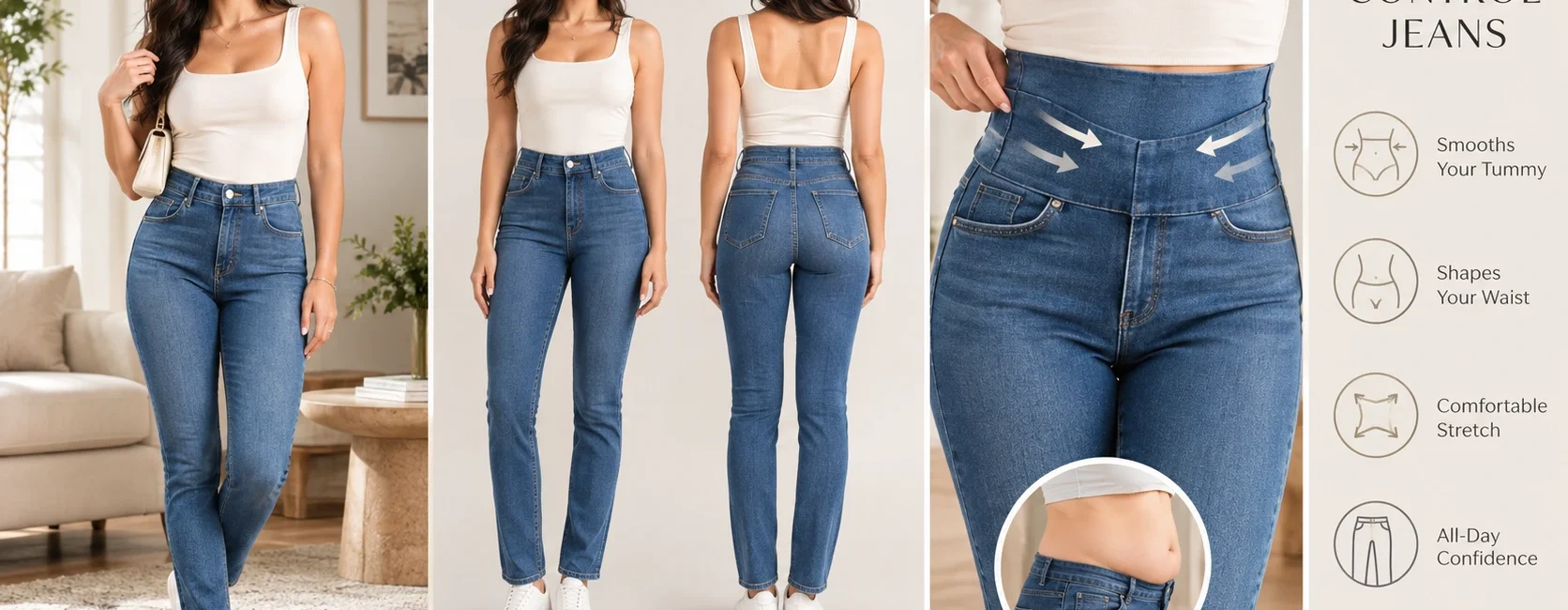
“Tummy control” gets stamped on jean tags so often that the phrase has basically stopped meaning anything specific. Some Tummy Control jeans genuinely reshape how your stomach looks under clothes. Others are just a regular pair of stretch jeans with a higher waistband and a marketing sticker. The difference comes down to which of two real engineering approaches a jean actually uses: compression fabric or structural seaming, and almost no product page explains which one you’re buying. Here’s what actually separates them, which one suits which body concern, and how to tell the difference before you buy.
The Two Real Technologies Behind “Tummy Control”
Compression fabric works the way shapewear works: a high-spandex or elastane-blend fabric applies even tension across the stomach, physically compressing soft tissue inward the same way a firm-hold legging or a Spanx garment does. Jeans built this way (think Spanx’s jeggings, or denim-look pull-ons with a heavy stretch-fabric front panel) rely on the fabric’s own elasticity to do the shaping work, rather than the way the garment is cut and sewn. This is the more aggressive, more immediately noticeable approach; you feel the compression the moment you put them on.
Smart seaming (sometimes called structural paneling) takes a completely different approach: rather than squeezing the stomach with fabric tension, the jean is engineered with an internal panel and specifically contoured seams that redistribute where fabric sits and how it moves with your body. NYDJ’s patented Lift Tuck Technology is the clearest, most documented example of this: a criss-cross inner panel combined with contoured side seams built directly into the structure of the jean, working from the inside without relying on raw compression. The brand specifically markets this as feeling like a regular jean rather than shapewear, and that’s the real practical distinction: structural seaming smooths and redirects rather than squeezing.
Most tummy control jeans on the market use one of these two approaches, or a blend of both: a stretch-heavy fabric combined with some structural panel work. Knowing which one you’re looking at tells you a lot about how the jean will actually feel to wear for eight hours.
Compression vs. Smart Seaming: The Real Tradeoffs
Compression fabric jeans:
- Deliver more noticeable, immediate shaping, closer to wearing shapewear.
- Tend to run warmer and less breathable, since the compression comes from denser, more elastane-heavy fabric.
- Can dig in at the waistband or thighs after several hours, especially with lower-quality stretch fabric that doesn’t fully recover its shape
- Often use a pull-on or jegging-style construction rather than a traditional zip-and-button jean.
Smart-seaming jeans:
- Feel closer to a regular pair of jeans, since the shaping comes from cut and construction rather than raw fabric tension.
- Generally more breathable and comfortable for all-day wear, since they’re not relying on constant fabric compression
- Deliver a subtler, smoothing effect rather than dramatic reshaping; this isn’t a replacement for shapewear if you want maximum compression.
- Often require sizing guidance specific to the brand. NYDJ, for example, states its Lift Tuck construction is built to be worn a size down from what you’d normally buy, which is a detail worth checking before ordering online.
Neither approach is objectively better; they’re solving for different priorities. If your main goal is the most dramatic possible smoothing and you’re comfortable with a firmer, shapewear-like feel, compression fabric delivers that more directly. If your priority is a jean you can wear from a 9-to-5 through dinner without adjusting or feeling constricted, structural seaming is generally the more comfortable long-day option.
What Every Tummy Control Jean Actually Shares
Regardless of which core technology a jean uses, a few supporting elements show up across almost all tummy control denim:
- A higher rise. Sitting higher on the natural waist rather than the hip does real, physical work regardless of any special panel; it naturally reduces how much the stomach can spill over the waistband, which is part of why “high-rise” and “tummy control” overlap so heavily in product listings even when no special panel exists at all.
- Stretch-blended denim. Almost no tummy control jean is 100% rigid cotton denim; a spandex or elastane percentage (commonly somewhere in the 2–10% range depending on the style) is standard, since zero-stretch denim can’t accommodate either shaping technology.
- A wider waistband. This helps distribute pressure over a larger surface area rather than concentrating it along one thin band, which reduces the classic “muffin top” effect regardless of which core technology sits behind it.
How to Tell Which Technology a Specific Pair Actually Uses
Product descriptions usually give this away if you know what to look for. Language like “compression panel,” “power mesh,” “shaping fabric,” or “firm hold” generally signals the compression-fabric approach. Language like “structural panel,” “engineered seam,” “criss-cross panel,” or a named proprietary construction (like Lift Tuck) generally signals the smart-seaming approach. If a listing only says “stretch denim” and “flattering fit” with no mention of an actual panel or construction detail, it’s worth being skeptical that combination alone (stretch fabric plus a higher rise) is sometimes marketed as “tummy control” without any dedicated shaping technology behind it at all.
Which Approach Suits Which Situation
Choose compression fabric if: you want maximum smoothing for a specific event or outfit, you’re comfortable with a firmer, more shapewear-like feel, and you don’t need to wear the jeans for a full, uninterrupted workday.
Choose smart seaming if: comfort and all-day wearability are your priority, you want something that reads and moves like a genuine pair of jeans rather than a jean-shaped compression garment, and you’d rather have consistent, moderate smoothing than dramatic but short-lived compression.
Consider both, for different purposes: plenty of people own one pair of each a compression-forward pair for occasions where maximum smoothing matters most, and a structural-seam pair as an everyday jean that happens to also smooth.
A Word on Sizing and Fit
Because both technologies rely on the garment’s construction as much as the size on the tag, sizing can behave differently than a standard jean. Structural-seam brands sometimes recommend sizing down, as noted above, while compression-fabric styles should generally be sized true-to-normal rather than sized down, since compression fabric needs enough coverage area to distribute tension evenly; sizing down a compression jean can concentrate pressure uncomfortably rather than smoothing evenly. Always check the specific brand’s sizing guidance rather than assuming your usual denim size transfers directly. If you’re shopping across a wider range of body types and fits generally, our guide to flattering jeans styling for plus-size fits covers additional fit and proportion considerations beyond just the tummy panel itself. And if color is part of your smoothing strategy alongside construction, our breakdown of dark wash jeans covers how a darker wash adds a visual slimming effect that works independently of, and alongside, either shaping technology.
If You Want More Control Than Jeans Alone Provide
Tummy control jeans, regardless of which technology they use, are generally more moderate in their shaping effect than dedicated shapewear, since a jean still needs to be comfortable enough to wear as an actual outer garment all day. If you’re deciding between relying on the jean’s built-in construction versus adding a separate shaping layer underneath, our guide to testing butt-lifting leggings before you buy covers similar compression-and-construction evaluation principles that apply directly to judging any shaping garment, jeans included, before committing to a purchase.
Frequently Asked Questions
What’s the actual difference between compression and smart-seaming tummy control jeans?
Compression fabric shapes by applying even fabric tension across the stomach, similar to shapewear, while smart seaming uses an internal structural panel and contoured seams to redistribute and smooth without relying on raw fabric compression.
Which type of tummy control jeans is more comfortable for all-day wear?
Smart-seaming jeans are generally more comfortable over a full day, since they don’t rely on constant fabric compression the way compression-fabric styles do.
Do tummy control jeans actually work, or is it just marketing?
Genuine tummy control jeans built with either compression fabric or a real structural panel do produce a measurable smoothing effect. However, some jeans marketed with the phrase are stretch denim with a higher rise and no dedicated shaping technology, so it’s worth checking the specific construction described in the product listing.
Should I size up or down for tummy control jeans?
It depends on the technology. Some structural-seam brands recommend sizing down as part of how their construction is designed to fit; compression-fabric styles generally should be sized true-to-normal, since sizing down can concentrate pressure unevenly.
Do tummy control jeans replace shapewear?
Not entirely. Tummy control jeans generally offer a more moderate shaping effect than dedicated shapewear, since they still need to function comfortably as an everyday outer garment rather than a compression-first undergarment.
How do I know if a pair of jeans has real tummy control technology or just a high rise?
Check the product description for specific language about a shaping panel, compression fabric, or a named construction technology. If the listing only mentions “stretch” and “flattering” without describing an actual panel or seam construction, it may just be a high-rise stretch jean marketed with the phrase rather than a jean with dedicated shaping technology.