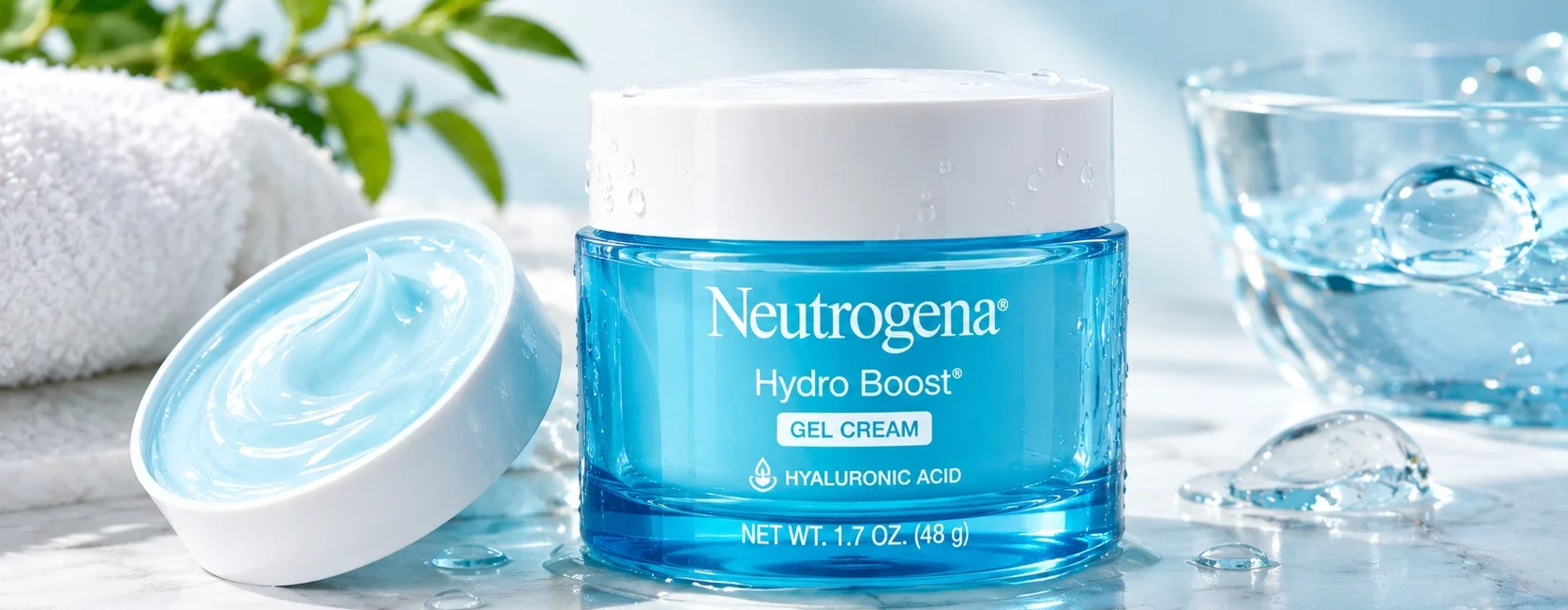
Neutrogena Hydro Boost Gel Cream is one of the most recommended drugstore moisturizers in the US, and for a specific reason: it delivers cream-level hydration in a texture that absorbs like a gel. But there’s a lot of confusion around this product, mainly because Neutrogena sells several Hydro Boost formulas that look nearly identical on the shelf, and because the formula itself has been meaningfully updated.
Gel Cream vs. Water Gel: The Difference That Trips Everyone Up
This is the single most important thing to get right before you buy, because the two products sit side by side and are easy to mix up.
Hydro Boost Gel Cream is formulated for extra-dry skin. It’s the richer of the two, with a velvety cream texture that transforms to a water-like feel on application. Neutrogena also positions it as suitable for sensitive and acne-prone skin, and the current US version is fragrance-free.
Hydro Boost Water Gel is formulated for normal, oily, and combination skin. It’s noticeably lighter, with a true gel texture, and the standard version contains fragrance.
If your skin feels tight, flaky, or genuinely dry, especially in winter, the Gel Cream is the one you want. If you’re oily or combination and mainly want lightweight hydration without heaviness, the Water Gel is the better match. Buying the wrong one is the most common reason people report that Hydro Boost “didn’t work” for them.
What’s Actually in Neutrogena Hydro Boost Gel Cream
The formula has been updated in recent years, and the current version is meaningfully different from the original. Here’s what the current ingredient list includes and why each part matters:
Hyaluronic acid (listed as sodium hyaluronate) is the headline ingredient. It’s a humectant, meaning it binds water and holds it at the skin’s surface. Neutrogena states it can hold up to 1,000 times its weight in water, a widely cited figure for hyaluronic acid generally, not a claim unique to this product.
Natural Moisturizing Factors (NMF) are the biggest addition in the reformulated version. These include a full set of amino acids (glycine, serine, alanine, arginine, proline, threonine, lysine, glutamic acid) plus PCA, sodium PCA, sodium lactate, urea, and sugars like trehalose, glucose, and fructose. NMF is what your skin naturally produces to hold onto moisture, and it depletes with age and environmental exposure, so including it is a genuine formulation upgrade rather than marketing dressing.
Ceramide NP and cholesterol/lanosterol esters appear in the current fragrance-free Gel Cream formula, alongside stearic and palmitic acid. These are barrier lipids the fats that hold your skin’s outer layer together. This is a meaningful addition, because hyaluronic acid alone draws water in but doesn’t do much to stop it from escaping. Lipids address that second half.
Glycerin sits high on the ingredient list as a second humectant, working alongside hyaluronic acid.
Dimethicone is a silicone that helps create a smooth surface finish and reduce water loss. It’s non-comedogenic despite persistent internet claims otherwise.
Electrolytes (sodium chloride, sodium PCA) are included to support ingredient absorption.
Neutrogena states the current formula is fragrance-free, paraben-free, phthalate-free, dye-free, non-comedogenic, dermatologist-tested, and allergy-tested. Formulas do get updated, so check the actual jar or box before buying if you have specific sensitivities.
What Neutrogena Claims (and How to Read Those Claims)
Neutrogena’s marketing for the current Gel Cream includes several specific figures worth understanding accurately:
- 9x more hydration instantly compared to untreated skin
- 72-hour hydration (clinically proven, per the brand)
- At 2 weeks: skin feels plump and glowing
- At 4 weeks: skin feels more resilient and deeply replenished
- 90% agree the formula feels weightless and absorbs quickly (US consumer data on file)
A few honest notes on reading these. The “9x more hydration” figure is measured against untreated skin, not against a competing moisturizer, so it tells you the product hydrates, not that it outperforms alternatives. The “90% agree” figure is consumer perception data, meaning people were asked how it felt, not an objective measurement. Neither of these is misleading, but they’re brand-run studies rather than independent research, and that’s worth knowing when comparing products.
How to Use It
Application is straightforward, but a couple of details make a real difference:
- Cleanse first. If you’re using a cleansing balm or oil-based first cleanse, our guide to cleansing balms worth trying covers how to build that step properly.
- Apply to slightly damp skin. This matters more than most people realize. With hyaluronic acid products, a humectant pulls moisture from wherever it can find it, so applying to damp skin gives it water to grab onto rather than pulling from deeper in your skin.
- Apply to face and neck after cleansing and any serums.
- Use morning and night. It works under makeup during the day and as a final step at night.
- Follow with sunscreen in the morning; this is a moisturizer, not an SPF product.
If you’re layering it with treatment serums, apply thinner, water-based serums first and the Gel Cream after. Our breakdown of the Beauty of Joseon Glow Serum covers a serum that layers well underneath a hydrating moisturizer like this one.
Who Should Buy It
Good fit if:
- You have genuinely dry or extra-dry skin and want hydration without a heavy, greasy finish
- You have acne-prone skin and need a non-comedogenic moisturizer that won’t add oil
- You’re sensitive to fragrance (the current US Gel Cream is fragrance-free)
- You want a reliable, widely available moisturizer at a reasonable drugstore price
- You wear makeup daily and need something that layers smoothly underneath it works well as a base before foundation application
Probably not the right pick if:
- Your skin is oily or combination; the Water Gel version is the better match
- You have very compromised, severely dry, or eczema-prone skin that needs a heavier occlusive balm
- You specifically want treatment actives (retinoids, vitamin C, acids); this is a hydrator, not a treatment product
Pros and Cons
Pros
- Genuinely lightweight texture despite delivering cream-level hydration
- Reformulated version includes NMF and ceramides, not just hyaluronic acid
- Fragrance-free, dye-free, non-comedogenic
- Widely available across US drugstores, Target, Ulta, Amazon, and warehouse clubs
- Reasonable price for the ingredient profile
Cons
- The Gel Cream vs. Water Gel confusion leads to a lot of mismatched purchases
- Contains silicones, which some people prefer to avoid (a preference, not a safety issue)
- Jar packaging is less hygienic than a pump and offers less ingredient stability over time
- Brand-run efficacy studies rather than independent research
- Not enough on its own for severely dry, cracked, or eczema-affected skin
What It Costs in the US.
Current U.S. pricing for the 1.7 oz jar typically runs around $20 to $27 depending on retailer, with regular promotional pricing bringing it closer to $19–$21 at places like Ulta and Target. Warehouse clubs occasionally stock two-packs at lower per-unit pricing. Larger sizes and fragrance-free variants are priced slightly differently. Prices shift with promotions, so it’s worth checking a couple of retailers before buying.
How It Compares to Other Drugstore Moisturizers
Hydro Boost Gel Cream sits in the same competitive tier as CeraVe’s moisturizing products and other drugstore hydrators. The broad distinction: CeraVe built its reputation on ceramides and barrier repair, while Hydro Boost built its reputation on hyaluronic acid and lightweight texture, though the reformulated Gel Cream has narrowed that gap by adding ceramides and lipids of its own.
If you’re weighing drugstore skincare brands against each other more broadly, our comparisons of CeraVe versus The Ordinary and La Roche-Posay versus Neutrogena for acne-prone skin go deeper into how these brands differ in formulation philosophy. And if gentleness is your main priority, our look at how Nivea’s creams compare to Aveeno for sensitive skin covers that end of the market.
A Note on Skin Concerns
This is a cosmetic moisturizer, not a treatment for a medical skin condition. If you’re dealing with persistent dryness that doesn’t improve with moisturizing, cracking, bleeding, severe itching, or a rash, that’s worth raising with a dermatologist rather than solving with a drugstore product. Similarly, if you experience irritation, stinging, or breakouts after starting any new product, stop using it and consult a professional if it persists.
Frequently Asked Questions
What’s the difference between Hydro Boost Gel Cream and Water Gel?
The Gel Cream is formulated for extra-dry skin with a richer texture, while the Water Gel is lighter and designed for normal, oily, and combination skin.
Is Neutrogena Hydro Boost Gel Cream good for acne-prone skin?
Neutrogena markets it as suitable for acne-prone skin, and it’s oil-free and non-comedogenic. That said, it’s a hydrator rather than an acne treatment, so it works alongside acne products rather than replacing them.
Does Hydro Boost Gel Cream contain fragrance?
The current US Gel Cream formula is fragrance-free. Some other Hydro Boost products in the range do contain fragrance, and formulations vary by market, so check the specific jar.
Can I use it under makeup?
Yes, it absorbs quickly and works as a makeup base. Give it a minute or two to settle before applying foundation for the smoothest result.
Does it contain ceramides?
The current fragrance-free Gel Cream formula includes Ceramide NP along with cholesterol and fatty acid lipids, which support the skin barrier alongside the hyaluronic acid.
How long does a jar last?
This depends on how much you use, but most people applying twice daily to face and neck get roughly two to three months from a 1.7 oz jar.
Is it worth the price?
For the ingredient profile hyaluronic acid, NMF complex, ceramides, and barrier lipids in a lightweight, fragrance-free base it’s competitively priced against other drugstore options in the same category. Whether it’s right for you comes down primarily to matching the formula to your skin type.