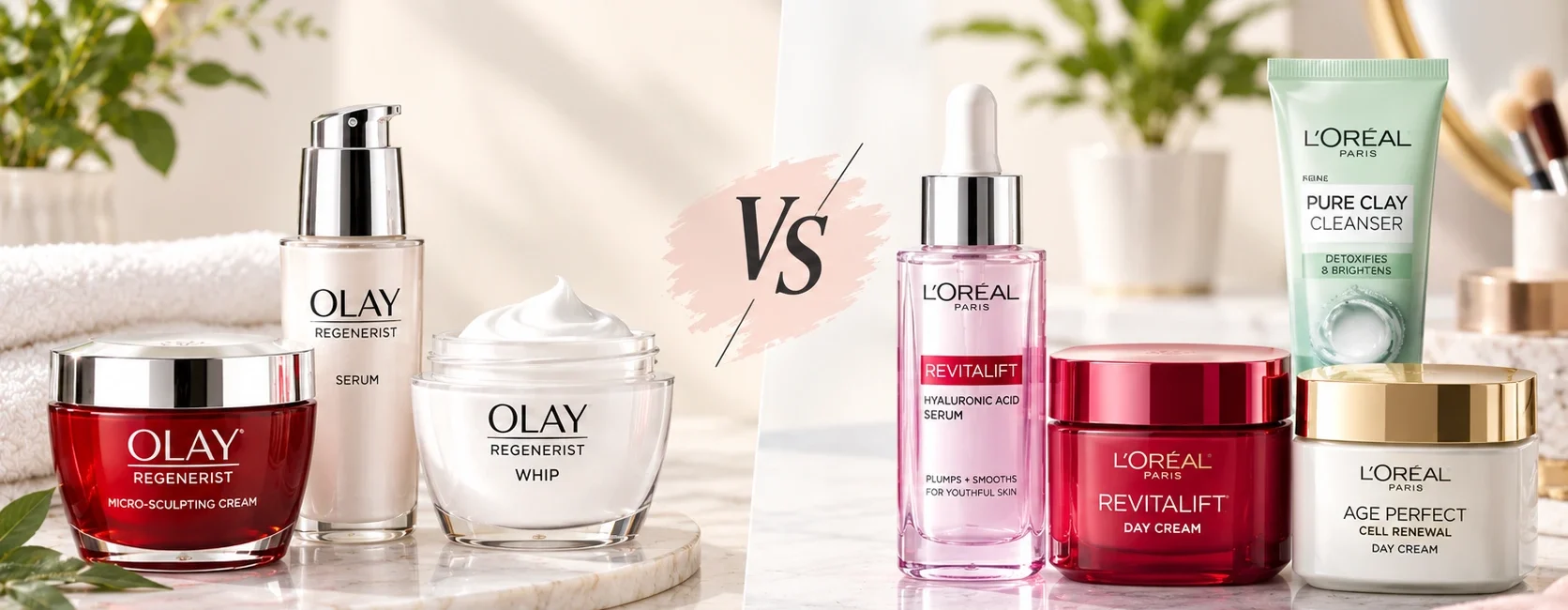
If you’re 30, working, and raising kids, you’re not looking for a ten-step routine. You want to know which drugstore brand actually delivers results in the four minutes you have before someone needs breakfast. Olay and L’Oréal are the two biggest names in that aisle, they’re priced similarly, and they make nearly identical claims which makes choosing between them genuinely confusing.
Here’s the short answer: Olay leans into niacinamide and peptides for barrier strength and gradual firming, while L’Oréal leans into retinol and hyaluronic acid for more visible texture and line correction. Olay is generally the gentler, lower-commitment option. L’Oréal tends to work faster but asks more of your skin. Which one wins depends less on the brand and more on what your skin needs at 30 and how much time you realistically have.
By RK Fashion Zone Editorial Team | A dedicated team researching and writing about modern fashion, beauty products, and practical outfit guides.
What Actually Changes in Your Skin at 30
Before comparing products, it helps to know what you’re treating. In your early thirties, collagen production has already begun its slow decline, cell turnover slows, and skin holds onto moisture less efficiently than it did at 25. For most people this shows up as:
- Fine lines that start to linger rather than disappear when your face relaxes
- Dullness or uneven texture, especially if you’re sleep-deprived
- Loss of the “bounce” that made skin look plump without effort
- Dark circles or under-eye puffiness that no longer resolves after one good night
Notably, sleep deprivation and elevated stress the actual daily reality of parenting young kids measurably affect skin barrier recovery. That’s not a marketing claim; it’s a genuine reason a product that works beautifully for someone sleeping eight hours might underperform for you. It’s also why barrier support matters more in this life stage than chasing aggressive actives.
Olay’s Approach: Niacinamide, Peptides, and Barrier Support
Olay’s flagship Regenerist line is built around niacinamide (vitamin B3) and peptides, with the Niacinamide + Peptide 24 moisturizer as the signature product. Olay states it uses 99% pure niacinamide and claims a 2x stronger skin barrier, along with the well-known marketing line that it hydrates better than significantly more expensive luxury creams.
Why this matters practically: niacinamide is one of the best-tolerated active ingredients in skincare. It strengthens the moisture barrier, helps with pore appearance and dark spots, regulates oil, and improves signs of aging and it does this without the purging, flaking, or sun-sensitivity adjustment period that retinol requires. For someone with limited time and no appetite for a two-week irritation phase, that’s a real advantage.
Olay also offers Retinol 24 for people who do want a retinoid, typically as a night cream paired with peptides and niacinamide, plus a fragrance-free version which is genuinely useful if fragrance irritates you.
Typical US pricing: Regenerist moisturizers run roughly $24–$30 for the core face creams, with Retinol 24 Night Cream around $25–$30. Olay Complete Daily Moisturizer with SPF 15 sits far lower, around $12 for a 6 oz bottle.
L’Oréal’s Approach: Retinol, Hyaluronic Acid, and Faster Visible Change
L’Oréal’s Revitalift line is the direct competitor, and it’s built on a somewhat more aggressive philosophy. The range includes Revitalift Triple Power (anti-aging moisturizer), Revitalift Derm Intensives with 1.5% pure hyaluronic acid, and Revitalift Laser Renew with retinol plus niacinamide.
The distinction is one of emphasis. L’Oréal puts pure retinol front and center in more of its mainstream products, at accessible price points. Retinol has the strongest body of evidence of any over-the-counter anti-aging ingredient for improving fine lines and texture but it also requires gradual introduction, consistent sunscreen use, and tolerance for an adjustment period that can involve dryness or flaking.
L’Oréal’s hyaluronic acid products, by contrast, are purely hydrating and as gentle as anything Olay offers.
Typical US pricing: Revitalift moisturizers generally run $20–$30, with serums in a similar band. Pricing across both brands is close enough that cost shouldn’t be the deciding factor.
Head to Head: Which Performs Better for Your Situation
For barrier strength and gentleness: Olay. Niacinamide-forward formulas are more forgiving when your skin is stressed, under-slept, or reactive. If you’ve tried actives before and found them irritating, start here.
For visible line and texture correction: L’Oréal. If your priority is specifically fine lines and you’re willing to build retinol tolerance over several weeks, L’Oréal’s retinol products give you more correction per dollar.
For pure hydration: roughly tied. Olay’s niacinamide-plus-glycerin formulas and L’Oréal’s 1.5% hyaluronic acid products both hydrate effectively. This comes down to texture preference more than performance.
For a genuinely minimal routine: Olay, mainly because the Complete Daily Moisturizer with SPF 15 collapses moisturizer and sun protection into one step at around $12. That single product solves the most commonly skipped step in any busy routine.
For sensitive skin: Olay’s fragrance-free options, or L’Oréal’s hyaluronic acid line while avoiding its retinol products. If sensitivity is your main concern, our comparison of how gentle Nivea’s creams are versus Aveeno covers the gentler end of the drugstore market in more detail.
A Realistic Four-Minute Routine
This is the part most comparison articles skip. Here’s what actually fits into a working parent’s morning:
Morning (2 minutes)
- Rinse or gentle cleanse
- Moisturizer with SPF or moisturizer, then separate sunscreen if you want a higher SPF than 15
That’s it. Sunscreen is the single highest-return anti-aging step at 30, well ahead of any active ingredient, and it’s the one people skip most often.
Night (3 minutes)
- Remove makeup and cleanse properly if you wear makeup daily, an oil or balm cleanser removes it far more effectively than a quick face wash. Our roundup of cleansing balms worth using covers options that make this step fast rather than fussy.
- Treatment moisturizer this is where your niacinamide or retinol product goes
- Eye cream if under-eyes are a concern
If you want to add one serum, add it at night between cleansing and moisturizer. Our look at the Beauty of Joseon Glow Serum covers a gentle option that layers well under either brand’s moisturizer.
Can You Mix the Two Brands?
Yes, and plenty of people do. There’s no formulation reason Olay and L’Oréal products can’t coexist in one routine they’re both mainstream cosmetic formulations without unusual incompatibilities.
The one rule worth following: don’t layer two retinol products, and don’t use a retinol product the same night as strong exfoliating acids unless your skin is well-adjusted to both. Otherwise, using Olay’s niacinamide moisturizer in the morning and L’Oréal’s retinol cream at night is a perfectly sensible combination and arguably better than committing entirely to either brand.
The Under-Eye Question
Dark circles are the most common complaint in this exact demographic, and it’s worth being honest: no drugstore eye cream reliably erases dark circles caused by genetics, thin skin, or sleep debt. Eye creams help with hydration, fine lines, and the appearance of puffiness. They don’t fix structural or vascular darkness.
If concealing is the faster win, our guide to applying concealer effectively covers technique that works better than product-switching. And if you want to add a treatment product with actual retinoid activity, our review of the Beauty of Joseon eye serum breaks down a retinal-based option at a comparable price point with the caveat that retinoids aren’t appropriate during pregnancy or breastfeeding.
How to Read the Claims on Both Brands
Both companies use language that sounds more definitive than the underlying data:
- “Hydrates better than the $100/$300/$500 cream” (Olay) compares hydration specifically, not overall anti-aging performance, and reflects brand-run testing.
- “Clinically proven” on either brand typically means a company-commissioned study, not independent peer-reviewed research.
- Percentage claims like “97% saw improvement” are usually consumer perception surveys people reporting how their skin felt rather than instrument-measured results.
None of this makes the products ineffective. Niacinamide, retinol, and hyaluronic acid all have genuine evidence behind them as ingredients. It just means the specific marketing figures aren’t the reason to choose one brand over the other.
The Practical Verdict
Choose Olay if: you want the lowest-friction option, your skin is sensitive or stressed, you value barrier strength over rapid correction, or you want moisturizer and SPF in one step.
Choose L’Oréal if: fine lines are your specific concern, you’re willing to introduce retinol gradually, and you’ll commit to daily sunscreen.
Choose both if: you want the most effective realistic setup a gentle niacinamide moisturizer with SPF in the morning, a retinol product at night a few times a week.
Whichever you pick, consistency matters far more than brand. A mid-range product used every night outperforms an excellent product used twice a month. If you’re still building the habit itself, our guide to why clear skin supports your overall style makes the case for treating it as a short daily investment rather than an occasional project.
Frequently Asked Questions
Is Olay or L’Oréal better for a 30-year-old?
Neither is universally better. Olay’s niacinamide-and-peptide approach suits sensitive or stressed skin and minimal routines; L’Oréal’s retinol products deliver more visible line correction if you can tolerate the adjustment period.
Can I use Olay and L’Oréal products together?
Yes. Just avoid layering two retinol products, and don’t combine retinol with strong exfoliating acids in the same routine until your skin has adjusted.
Which is better for sensitive skin?
Olay’s fragrance-free niacinamide formulas are generally the gentler starting point. L’Oréal’s hyaluronic acid products are also gentle; its retinol products are not the place to start.
Do I need a separate eye cream at 30?
Not necessarily. If your main concern is hydration, your regular moisturizer applied carefully around the orbital bone is often sufficient. A dedicated eye product makes more sense if you’re targeting fine lines specifically.
Is retinol safe if I’m pregnant or breastfeeding?
Retinoids are generally advised against during pregnancy and breastfeeding. Stick to niacinamide, hyaluronic acid, and peptides during that period, and confirm with your doctor.
How long before I see results?
Hydration improvements show within days. Texture and tone changes from niacinamide typically take four to eight weeks, and retinol results on fine lines generally take twelve weeks or more of consistent use.